
Why Canadian Businesses Should Go Solar and Install Battery Energy Storage
Canadian businesses are facing an unprecedented operational challenge: the dual pressure of skyrocketing electricity rates and the urgent call for sustainability. The traditional energy model is not only becoming cost-prohibitive but is also a risk to long-term competitiveness. In this environment, forward-thinking corporations are adopting a synergistic approach to secure their power supply and their bottom line.
Commercial solar and battery energy storage in Canada is no longer a fringe green initiative; it is a critical financial and resilience strategy. This guide breaks down the crisis and details why integrating these two technologies is the smartest investment a Canadian enterprise can make today.
The Rising Storm: Electricity Costs as a Primary Threat
For too long, Canadian businesses have viewed energy as a fixed, albeit rising, cost. That passivity is no longer tenable. We are witnessing a monumental shift in the utility landscape across the country.
High Electricity Rates in Canada
Whether you are operating a manufacturing plant in Ontario or a commercial real estate portfolio in Alberta, you have felt the sting. The base electricity commodity rates are rising across nearly all jurisdictions, driven by the colossal capital required to renew aging generation, transmission, and distribution infrastructure.
The Upward Trend
This is not a temporary spike. Projections uniformly suggest that power rates in Canada will continue their upward trajectory for the next decade. Utilities are filing multi-year rate design applications that forecast consistent increases, making passivity the most expensive option for Canadian business planning. Generating your own clean energy right on your roof or property provides instant, long-term financial certainty.
The Hidden Killer: Demand Charges
For many commercial and industrial operations, the actual cost per kilowatt-hour of energy consumed is only part of the problem. Demand charges often account for 30% to over 50% of a business’s entire electricity bill.
Utilities levy demand charges based on the single highest amount of power your facility draws during any short window (typically 15 minutes) throughout the entire billing cycle. One heavy piece of machinery kicking in at an inopportune moment can set your entire monthly rate structure. A standalone solar array cannot prevent these spikes, as they may occur during non-production hours or on overcast days. This is where the synthesis of solar and battery storage creates its defining advantage.
What is Commercial Solar and BESS?
To understand the solution, we must first break down the components and how they function together for commercial demand management.
Solar Photovoltaic (PV) Systems
These are arrays of high-performance, dark monocrystalline or polycrystalline panels installed on a building’s expansive rooftop, ground-mounted, or incorporated into a parking canopy. These systems convert peak daytime sunlight directly into clean, usable electricity for your property.
Battery Energy Storage Systems (BESS)
A commercial BESS is an on-site, localized container of highly advanced, high-capacity batteries (typically lithium-iron-phosphate for safety and longevity). This system prioritizes absolute energy containment and resilience. A stand-alone solar system without storage is forced to interact with the grid immediately, exporting surplus during high production and importing during non-production, which does not reduce demand charges.
A smart BESS acts as a sophisticated energy reservoir, dynamically managed to prioritize immediate self-consumption and battery retention. It can be programmed to perform crucial functions that a standalone solar system cannot, such as peak shaving and energy arbitrage.
The Synthesis: How Solar + BESS Works
The magic of this dual energy strategy lies in how the two technologies work together to deliver financial independence:
Solar Generation: Your PV array creates massive amounts of power during the day when grid rates are often at their highest.
Solar Priority: The system prioritizes immediate self-consumption, directly powering your facility with $0/kWh energy.
Solar Charge: If production outpaces immediate demand, the surplus is redirected to charge the BESS reservoir, rather than flowing into the public grid for a lower credit value.
The BESS Intervention (Dynamic Management): This is the game-changer. The smart controller monitors your building's grid draw in real-time. When it detects a high-load peak (the 15-minute window that sets your demand charge), it instantly and seamlessly discharges the high-value stored solar power to "shave" that peak. From the utility’s perspective, your demand has flattened, leading to massive, immediate structural bill reductions.
Energy Arbitrage in Ontario: On time-of-use (TOU) or ultra-low overnight (ULO) rate plans, the BESS can also perform energy arbitrage. It can be programmed to charge from the grid at night when rates are pennies (the ultra-low window) and discharge that cheap power during the day during mid- or on-peak windows, insulating your entire property from future utility rate restructuring.
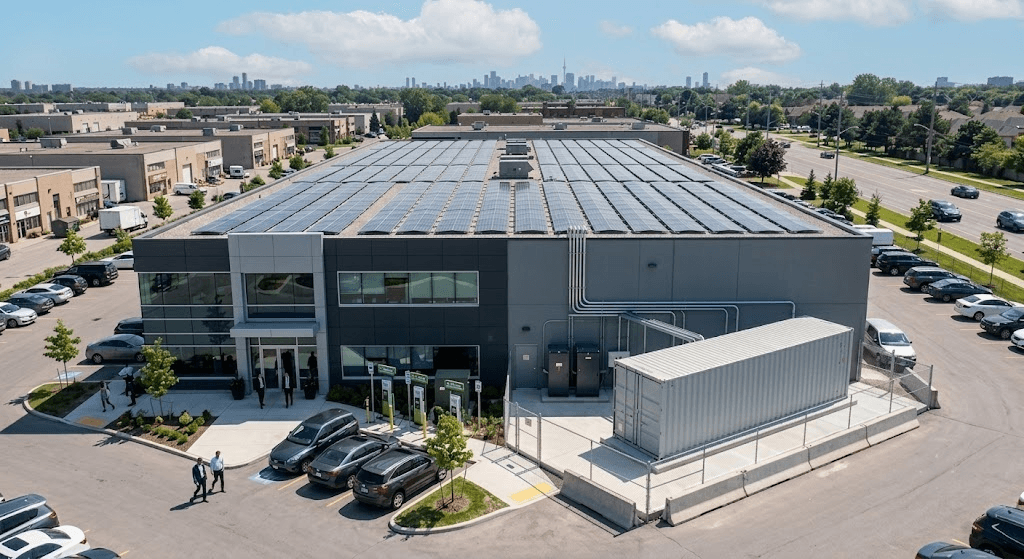
Why Canadian Businesses Must Install Solar and BESS
The synthesis of these two technologies delivers a powerful multi-channel return on investment (ROI).
1. Massive Financial Incentives
The incentive framework for commercial solar and battery energy storage in Canada has been heavily streamlined, rewarding corporations that act decisively before seasonal deadlines pass.
Comprehensive Provincial Commercial Rebate List (as of mid-2026)
This table summarizes active provincial government or utility-funded cash-back grants. We strongly encourage you to consult our regional Atlantic engineering team for immediate help fast-tracking your paperwork and capturing these finite funding allocations.
| Province / Region | Specific Incentive Program | Target / Limit | Financial Impact (Summary) |
|---|---|---|---|
| Ontario | Save on Energy Retrofit Program | Rooftop standalone solar arrays between 10 kW and 1 MW. Behind-the-Meter (BTM) load displacement via BESS is optional but must remain strictly non-exporting. | Pre-June 30, 2026: $860 per kW AC. • Post-June 30, 2026: Base incentive drops 10% to $770 per kW AC. |
| Alberta | Capital Retrofits (Current Status: Waitlisted) | Commercial, industrial, and agricultural retrofits that reduce building energy usage and greenhouse gas emissions by at least 5% against a verified historical baseline. | Capped at a maximum of $250,000 per project (up to 20% of total eligible costs): • Systems < 15 kW: $0.65 per watt. • Systems 15 kW to 2 MW: $0.50 per watt. |
| British Columbia | BC Hydro Business Solar Rebate | Grid-connected standalone solar PV and standalone BESS assets. Systems must be configured for clean load displacement (self-consumption). | Funding covers up to 50% of total product and installation costs. • Standard Business / Multi-Unit Buildings: Capped at $10,000 for solar and $10,000 for BESS (Total potential: $20,000). • Social Housing, Indigenous Bodies, & Remote Microgrids: Expanded caps of $50,000 for solar and $50,000 for BESS (Total potential: $100,000). |
Federal Tax Credits and Depreciation Write-Offs
While residential buyers rely on provincial streams, commercial operations have access to deeply aggressive federal tax instruments that anchor the long-term ROI:
| Incentive Instrument | Type | Financial Impact / Benefit |
|---|---|---|
| Federal Clean Technology ITC | Refundable Investment Tax Credit | A strict 30% cash-back on the total capital acquisition and equipment cost of both the solar panels and the BESS assets. |
| Accelerated Capital Cost Allowance (CCA) | First-Year Depreciation write-off | Write off 100% of the asset cost in the very first year under Class 43.1/43.2, drastically lowering corporate tax liabilities. |
Note on the 30% Refundable ITC: Because this credit is fully refundable, if your corporate entity or commercial farm does not owe corporate tax that fiscal year, the Canada Revenue Agency (CRA) will issue a direct refund check for the full 30% value.
2. Significant Long-Term Benefits
The benefits of combining solar and BESS extend decades beyond immediate rebate capture, providing a competitive edge you can capitalize on.
Substantial Electricity Savings (Arbitrage and Peak Shaving) A synergistic approach turns your roof into a reliable, cost-saving asset. You lock in a massive chunk of your energy costs at a $0/kWh production rate. When you stack demand charge reduction (peak shaving) with energy arbitrage (dynamic time-shifting) and efficient solar production, payback terms remain highly competitive, often at 6 to 10 years, depending on your specific utility rate plan.
Enhanced Power Reliability (Resiliency) Canada’s climate is increasingly volatile, susceptible to extreme winter ice storms and maritime weather anomalies. In a province facing these challenges, a behind-the-meter battery setup provides true grid resiliency and emergency backup power. A standalone solar system cannot operate during an outage; a solar + BESS setup switches into island mode, prioritizing continuous operation for critical medical facilities, data centers, cold storage, or manufacturing lines, bypassing utility rate hikes entirely.
Corporate Sustainability Goals (ESG) Consumers are increasingly preference-driven, moving toward brands that demonstrate true environmental responsibility. Deploying commercial solar and battery energy storage Canada-wide provides immediate, measurable progress toward your corporate sustainability goals (ESG scores). This improves LEED certification potential and can be powerfully leveraged in marketing campaigns, appealing to eco-conscious customers and often being required by major corporate clients.
Increasing Property Value Adding clean, revenue-generating technology with immediate operating cost reductions increases annual income. This translates directly to increased property value by lowering operating expenses, effectively growing the valuation of your real estate portfolio, which can often be achieved through localized improvement charges with PACE financing, bypassing traditional bank loans.
Which Industries Can Take Advantage?
While any commercial property can benefit, a synergistic solar-plus-storage approach is optimized for high-load or high-electrification operations:
Manufacturing and Industrial: Heavily energy-intensive facilities (e.g., steel, metal, cement) face punishing demand charges. BESS peak shaving is optimized for this segment.
Commercial Real Estate (Offices & Retail): Large rooftop arrays in city centers with Time-of-Use rates are prime candidates for load displacement and TOU optimization, especially with heat pumps.
Cold Storage & Food Processing: Constant, high baseline loads with massive penalties for power loss make BESS resilience invaluable.
Data Centers: dependent on power available 24 hours a day to avoid global infrastructure disruptions. BESS offers dynamic load response and replaces diesel setups for resilient microgrids.
Agricultural Operations: Greenhouses, aquaculture, and grain storage need stable pricing. Many professional solar installers across the country provide private financing plans tailored to this sector.
Hospitality & Institutions (Schools/Hospitals): Predictable usage patterns make a 1-to-1 retail credit structure a highly favorable financial framework for long-term budget planning.
Act Before the Window Closes
The era of passivity is ending. The golden windows for both provincial and federal funding allocations are rapidly tightening. Submitting interconnection applications ahead of fast-approaching seasonal boundaries is essential. Timing is everything: contact our specialized Atlantic engineering team today for a comprehensive, free virtual property assessment, project your long-term ROI, and structure your application to capture every active municipal, provincial, and federal incentive while they remain active.
[Request Your Free Canadian Commercial Solar & BESS Assessment Now]
People Also Ask
1. What is the typical payback period for a commercial solar and BESS installation in Canada?
Payback terms vary by province, specific utility rate plan, and system design, but the landscape is increasingly competitive. By combining provincial incentives and the aggressive federal tax provisions, payback periods typically range from 6 to 10 years. The most reputable turnkey solar providers will provide a detailed breakdown to ensure your project is completely seamless and cash-flow positive as earlier as possible.
2. Can we still net-meter a ground-mount commercial solar array?
This depends heavily on your specific utility and province. Saskatchewan’s program, for example, typically excludes ground-mount solar from net metering eligibility. In contrast, Nova Scotia Power and BC Hydro often permit it under commercial micro-generation rules. However, to capture certain direct rebates, such as Ontario’s Business Retrofit Program, the system must be a non-exporting(load displacement) rooftop-mounted design. You must consult with top-tier local solar contractors to map your localized grid hosting capacity and ensure compliance with provincial micro-generation rules.
3. How do property taxes affect the ROI on commercial solar in Canada?
It depends on the province. Fortunately, most Canadian jurisdictions offer property tax exemptions or strict mandates. In New Brunswick and Prince Edward Island, adding a residential or commercial solar system will not trigger an increase in your annual property tax assessment. Conversely, property owners must carefully consider municipalities that do not have active property tax financing (like Alberta's CEIP) or established PACE property-linked financing. You must check local municipal guidelines to confirm if your solar equipment property tax exemption is secure.
4. Is maintenance required for commercial solar and battery systems?
Minimal. Solar sytems have no moving parts and are heavily streamlined; leading monocrystalline panels carry a 25-year performance warranty and are designed to last over 30 years, with solar panels maintaining approximately 85% of original output. BESS containers are essentially self-contained generating assets requiring very minimal oversight beyond routine checkups.
5. What is the maximum system size allowed under net metering programs in Canada?
Under current regulations, there is significant variance. For example, Prince Edward Island’s micro-generation rules allow grid-tied net-metering systems up to 100 kW. In other provinces, the deregulated commercial caps are expanding up to 500 kW or even 1,000 kW (1 MW). Systems must be sized accurately to offset your real, historical annual electrical load; over-sizing a system significantly beyond your property's annual consumption is not permitted under provincial micro-generation rules to prevent overloading localized grid hosting capacity.