Alberta Solar Guide 2026: The Comprehensive Guide to Residential and Commercial Solar
With some of the highest solar potential in Canada and a unique deregulated energy market, Alberta has quietly built the fastest solar payback ecosystem in the country. In 2026, the economics of solar power are shifting away from traditional nationwide upfront federal grants and moving toward hyper-local incentives, innovative financing, and smart billing platforms.
Whether you are a homeowner looking to wipe out your utility bills or a commercial property manager seeking to hedge against volatile electricity costs, this Alberta Solar Guide 2026 outlines everything you need to know about setting up solar, maximizing your ROI, and capitalizing on the latest provincial frameworks.
Understanding Net Billing in Alberta
At the heart of every Alberta solar system is the province’s Micro-Generation Regulation. Since there is no physical "grid-as-a-battery" that stores excess power for you indefinitely, Alberta utilizes a highly dynamic net billing system.
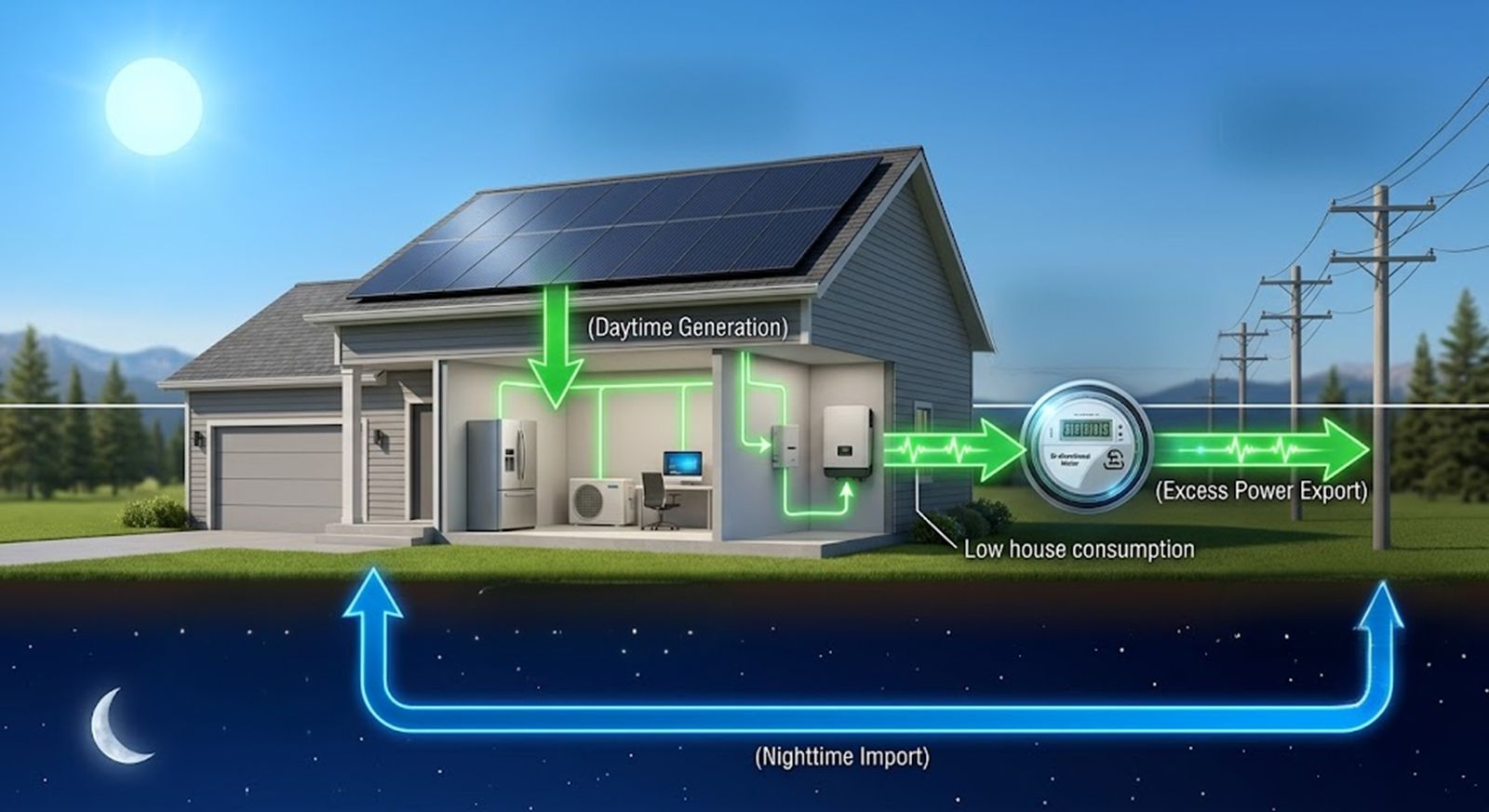 When your solar panels generate electricity during peak daylight hours, that power is immediately used to run your property's appliances, lights, and heating systems. When production exceeds your immediate needs, the surplus travels backward through a bi-directional utility meter and onto the local grid.
The Dollar-Credit Basis: Your utility provider tracks every single kilowatt-hour (kWh) exported. You receive a monetary credit for every exported kWh.
Rate Matching: Crucially, your export credit rate matches the exact rate at which you purchase electricity from your retailer. If you are on a high rate, you earn high credits; if you are on a low rate, you earn low credits.
Annual Settlement: The net billing framework is calculated over a rolling 12-month period. Any accumulated credit surplus at your annual anniversary is paid out to you directly as a cash payment, making it critical not to oversize your system beyond your annual consumption needs.
The Ultimate Economic Lever: Alberta Solar Club Rates 2026
No discussion about solar in Alberta is complete without the Solar Club. Created by UTILITYnet and offered across more than 15 municipal energy retailers, this program is the main reason Alberta's solar economics are so powerful.
The Solar Club allows micro-generators to switch back and forth between a high rate and a low rate depending on the season. In 2026, the updated rates are:
The HI Rate - 35.00¢/kWh: Homeowners typically switch to this elevated rate in the sunny spring and summer months (April to October). Because your solar panels are producing a massive surplus during this time, you export electricity at a whopping 35 cents per kWh, quickly racking up hundreds of dollars in billing credits.
The LO Rate - 5.90¢/kWh: In the dark winter months (November to March) when snow covers the panels, you switch back to this lower rate. This minimizes the cost of the electricity you must import from the grid.
Automatic Switching: Starting in early 2026, automatic rate-switching has gone live, optimizing your rates with zero manual effort required.
Residential and Commercial Alberta Solar Incentives 2026
With the Canada Greener Homes Grant permanently closed to new applicants in February 2024, and the Canada Greener Homes Loan officially shut down in October 2025, the incentive landscape has pivoted. Here is where the rebates and financing streams sit in 2026:
1. Residential Solar Rebates & Financing
While there is no single province-wide residential solar cash rebate, homeowners have two powerful avenues to drastically reduce upfront costs:
CEIP Financing Alberta Solar: The Clean Energy Improvement Program (CEIP) has expanded to over 20 municipalities in Alberta, including Calgary and Edmonton. It allows you to finance up to 100% of your solar installation with competitive interest rates (range of 5.66% to 5.75%) over terms up to 20 years. Crucially, the financing is tied to your property tax bill rather than you personally, meaning it transfers to the new owner if you sell your home.
Local Municipal Rebates: Direct cash incentives can still be stacked depending on where you live:
Banff - Solar Incentive Program: $450 per kW installed (capped at $9,000 for residential properties).
Spruce Grove - Clean Energy Improvement Program: The strongest active 2026 offer, combining CEIP financing rate with a 7.5% direct rebate applied to your tax bill.
Canmore - Solar Incentive Program: A flat $1,250 residential rebate.
2. Commercial Solar Incentives
For businesses, agricultural operations, and industrial facilities, the financial case is even stronger due to aggressive tax restructuring.
Commercial Solar Tax Credits Canada 2026: Under the federal Clean Technology Investment Tax Credit (ITC), commercial enterprises can claim a 30% refundable tax credit on the total cost of their solar photovoltaic installations. For a $200,000 business installation, this translates into an immediate $60,000 cash reduction in federal tax liabilities.
Accelerated Capital Cost Allowance (CCA): Solar equipment falls under Class 43.1 or 43.2, enabling businesses to write off 100% of the system cost in the very first year. This can compress payback periods to a mere 5 to 7 years.
How to Stack Solar Rebates in Alberta 2026
Maximizing your return on investment requires careful sequencing. Follow this step-by-step blueprint to stack every available incentive:
Secure Financing First: Submit your application to your municipality's CEIP portal to secure low-interest financing before starting any construction.
Design & Install: Work with a qualified local installer to design a system sized perfectly to match your annual consumption profile to satisfy Micro-Generation regulations.
Claim Municipal Cash or Solar Rebate: After the final utility inspection, submit your invoices to claim local post-installation cash rebates (such as Banff’s or Canmore's grants).
Enroll in the Solar Club: Sign up with a qualifying energy retailer and make sure your rate-switching is active.
Commercial Filing: If you are a business owner, submit your 30% Clean Tech ITC and 100% first-year CCA depreciation write-off on your next corporate tax return.
Navigating municipal portals, federal tax structures, and utility agreements on your own can be daunting. The absolute best way to ensure you don’t leave money on the table is to partner with a turnkey solar installer who has deep expertise in managing these financial mechanisms. A specialized installer will handle the administrative heavy lifting from day one, seamlessly aligning every incentive to slash your total project cost.
Take Control of Your Utility Bills Today
Alberta’s deregulated energy market rewards proactive, strategic thinking. By matching modern net billing policies, the high-earning 35¢/kWh Solar Club rate, and municipal CEIP financing, you can generate immediate positive cash flow with low upfront expenses.
Ready to see what solar can do for your home or business? Contact our expert engineering team today for a free custom solar design, exact ROI assessment, and a comprehensive breakdown of the rebates available in your specific Alberta municipality.
[Get Your Free Alberta Solar & Rebate Assessment Now]
People Also Asked
1. Are there still federal solar rebates in Canada for homeowners in 2026?
No. There are currently no active direct federal rebates or interest-free loans available for residential solar panel installations in Alberta. The Canada Greener Homes Grant and the Canada Greener Homes Loan programs are both fully closed to new applications. To finance a solar project in Alberta today, homeowners should instead leverage the property-linked Clean Energy Improvement Program (CEIP). If the CEIP is not yet active in your specific municipality, you can look into competitive private financing options and customized solar loans offered directly through your solar installer.
2. Can I get a provincial solar rebate directly from the government of Alberta?
No, the provincial government of Alberta does not offer a direct, province-wide cash rebate or tax credit for solar installations. Instead, the province relies on the legal net billing framework (governed by the Micro-Generation Regulation), the Solar Club program, and property-tax-backed CEIP financing programs to make solar highly profitable.
3. What is CEIP, and what happens if I sell my home?
The Clean Energy Improvement Program (CEIP) is a low-interest financing tool available in over 20 Alberta municipalities. It allows you to finance up to 100% of your solar installation with fixed rates over a 20-year term. Because the loan is attached directly to the property rather than you as an individual, you do not have to pay it off upon selling; the remaining financing obligation seamlessly transfers to the home buyer as part of their property taxes.
4. How do I qualify for the commercial 30% solar tax credit in 2026?
To qualify for the federal Clean Technology Investment Tax Credit (ITC), your solar installation must be built for a taxable Canadian corporation. The 30% credit is fully refundable, meaning that even if your business does not owe any corporate tax in the year of installation, the CRA will cut your business a direct refund check for the full credit value.