
Ontario Solar Guide 2026: The Definitive Residential and Commercial Blueprint
Ontario’s energy landscape is experiencing a massive shift in 2026. Driven by rising electricity costs, ongoing grid modernization, and updated provincial regulations, the case for deploying solar panels has never been stronger. While the historic Canada Greener Homes Loan is a memory of the past, a fresh suite of target-driven incentives, structural policy changes, and evolving utility frameworks are redefining the return on investment (ROI) for solar adopters.
Whether you are a homeowner looking to offset Time-of-Use (TOU) billing peaks or a corporate executive attempting to shield an enterprise from escalating overhead, this Ontario Solar Guide 2026 outlines the active pathways, financial programs, and regulatory updates needed to successfully transition to solar power.
The Trend of Solar in Ontario
Solar adoption across Ontario is moving past the early-adopter phase and entering the mainstream financial playbook. The single largest driver is long-term inflation protection. With Hydro One and urban local distribution companies (LDCs) forecasting steady multi-year rate hikes, generating electricity on your own roof establishes immediate cost certainty.
Additionally, the conversation in 2026 has expanded from simple solar panel arrays to smart, integrated energy systems. Homeowners and commercial operators are increasingly pairing solar installations with Battery Energy Storage Systems (BESS). This evolution is heavily motivated by Ontario’s variable Time-of-Use (TOU) and Ultra-Low Overnight (ULO) pricing, allowing consumers to store solar energy during peak production and discharge it when grid prices are highest.
On the financing side, municipal property-tied funding is a dominant trend. Localized property-tax financing models—like the Toronto Home Energy Loan Program (HELP) allow owners to finance up to $125,000 at highly competitive interest rates for a 20-year term. These loans stay with the property's tax bill rather than the individual, entirely preserving personal debt-to-income ratios.
Ontario Regulated Price Plan (RPP) Rates
Here is the structured breakdown of Ontario’s current residential and small business electricity price plans. These figures represent the base electricity commodity charge set by the Ontario Energy Board (OEB).
1. Time-of-Use (TOU) Price Plan
The standard plan focuses on shifting heavy appliance use away from the midday peak hours during the summer season.
| TOU Period | Price | Hours of Application (Summer: May 1 – Oct 31) | Hours of Application (Winter: Nov 1 - Apr 30) |
|---|---|---|---|
| Off-Peak | 9.8¢ / kWh | Weekdays from 7:00 PM to 7:00 AM; all day weekends and statutory holidays | Weekdays from 7:00 PM to 7:00 AM; all day weekends and statutory holidays |
| Mid-Peak | 15.7¢ / kWh | Weekdays from 7:00 AM to 11:00 AM and 5:00 PM to 7:00 PM | Weekdays from 11:00 AM to 5:00 PM |
| On-Peak | 20.3¢ / kWh | Weekdays from 11:00 AM to 5:00 PM (Peak A/C demand window) | Weekdays from 7:00 AM to 11:00 AM and 5:00 PM to 7:00 PM (Peak Heating demand window) |
2. Ultra-Low Overnight (ULO) Price Plan
The ULO plan expands the price spread, making it ideal for solar-plus-battery storage systems looking to avoid high evening peak rates. Unlike TOU, these time windows remain identical in both summer and winter.
| ULO Period | Price | Hours of Application (Year-Round) |
|---|---|---|
| Ultra-Low Overnight | 3.9¢ / kWh | Every day from 11:00 PM to 7:00 AM (Lowest rate in Canada) |
| Weekend Off-Peak | 9.8¢ / kWh | Weekends and statutory holidays from 7:00 AM to 11:00 PM |
| Mid-Peak | 15.7¢ / kWh | Weekdays from 7:00 AM to 4:00 PM and 9:00 PM to 11:00 PM |
| On-Peak | 39.1¢ / kWh | Weekdays from 4:00 PM to 9:00 PM (Highest rate window) |
The Arbitrage Opportunity: Notice the 35.2¢ / kWh price delta between ULO overnight (3.9¢) and ULO on-peak (39.1¢). Pairing solar panels with an intelligent home battery lets you store low-cost energy and discharge it during that expensive 4:00 PM to 9:00 PM weekday window, effectively wiping out the most expensive charges on your bill.
Net Metering vs. Behind-the-Meter in Ontario
The choice of how your solar installation interacts with the grid is the most critical technical decision you will face. In Ontario, grid-connected projects follow two primary pathways: Ontario net metering 2026 frameworks or non-exporting Behind-the-Meter (BTM) load displacement.
1. Grid-Tied Net Metering (The Export Model)
For most residential and small business properties, tying into the grid via net metering remains the gold standard.
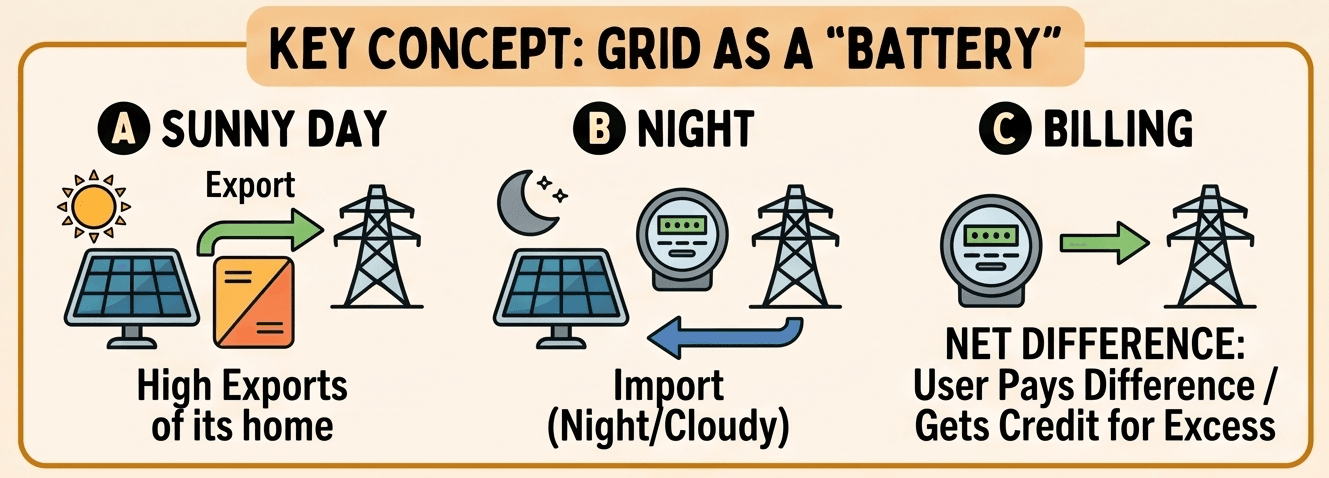
The Mechanism: Your system routes clean power to your property first. When production outpaces demand (like a sunny afternoon), the surplus is automatically exported to the utility grid via a bi-directional meter.
The Credits: Your utility (e.g., Hydro One, Toronto Hydro, Alectra) issues a 1-to-1 credit at full retail rates against the electricity you consume during non-production hours. Credits can be rolled forward progressively for up to 12 months to offset winter usage.
The Major 2026 Update: As of May 1, 2026, the Ontario Energy Board officially raised the micro-embedded generation threshold from 10 kW to 12 kW. This is an immense win for homeowners. Moving the limit to 12 kW allows larger, highly electrified households to bypass costly Connection Impact Assessments (CIAs) and complex engineering validation, significantly cutting down approval timelines to roughly 60 days.
2. Behind-the-Meter Systems (The Non-Export Model)
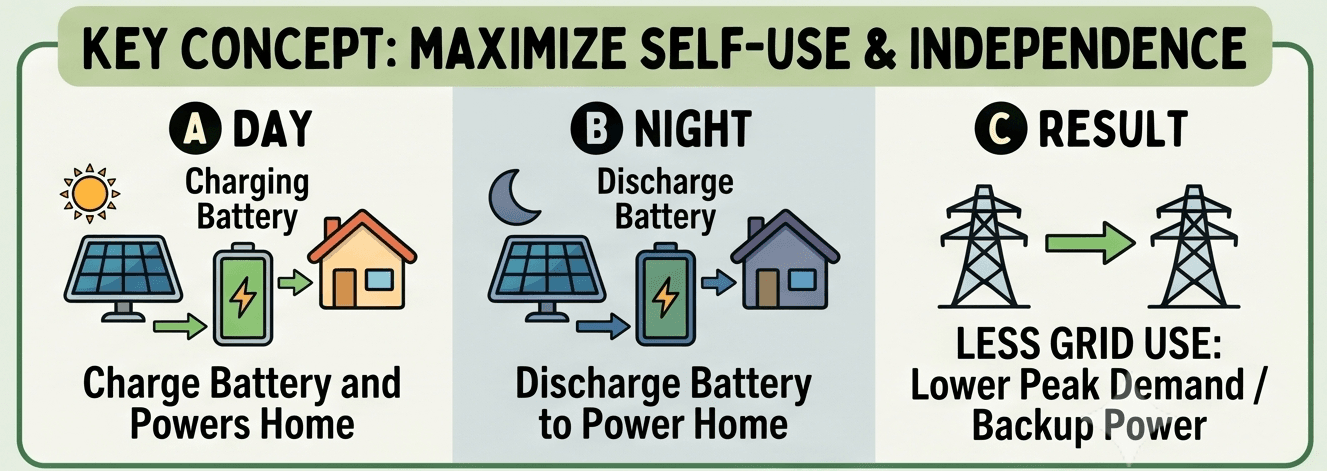
A Behind-the-Meter (BTM) setup prioritizes strict localized containment and structural independence.
The Mechanism: The solar system feeds energy directly to your building and an on-site battery network (like a Tesla Powerwall 3 or Enphase IQ system). Zero electricity is exported back to the public utility distribution network.
The Strategic Trade-Off: In Ontario, choosing between these two paths introduces a major structural trade-off. To qualify for the province's largest direct cash-back incentives, the system must be a non-exporting design. Conversely, grid-tied net-metering systems are locked out of certain upfront grants, forcing consumers to pick the option that best aligns with their long-term operational goals.
Residential and Commercial Rebate Structures
The incentive framework for 2026 rewards swift, decisive action. Both provincial and federal entities have structured current funding channels to incentivize immediate, high-efficiency adoptions.
Residential Rebates: The Home Renovation Savings Program
The leading financial tool for Ontario homeowners is the provincial Home Renovation Savings Program solar stream, which remains active through November 2026 on a first-come, first-served basis:
Solar Panel Rebate: Offers $1,000 per kW installed, capped at a maximum of $5,000 (equivalent to a 5 kW allocation).
Battery Storage Rebate: Provides $300 per kWh, capped at an additional $5,000 when a behind-the-meter battery storage system is paired with new solar.
Important Caveat: To unlock up to $10,000 in combined rebates, applications must be submitted via a Save on Energy registered contractor before purchasing any equipment, and the system must remain non-exporting (no grid net metering).
Commercial Rebates: Save on Energy Retrofit Program & Federal ITCs
For commercial spaces, agricultural facilities, multi-residential complexes, and industrial warehouses, the fiscal landscape is incredibly aggressive but carries a strict mid-year deadline:
| Incentive Program | Mechanism | Financial Value / Impact |
|---|---|---|
| Save on Energy Retrofit Program (Pre-June 30, 2026) | Prescriptive Solar Cash Rebate | $860 per kW AC for rooftop systems over 10 kW up to 1 MW. |
| Save on Energy Retrofit Program (Post-June 30, 2026) | Prescriptive Solar Cash Rebate | $770 per kW AC for rooftop systems over 10 kW up to 1 MW. |
| Clean Technology Investment Tax Credit | Refundable Federal Tax Credit | 30% cash-back on the total capital acquisition cost of solar and BESS assets. |
| Accelerated Capital Cost Allowance (CCA) | First-Year Depreciation Write-Off | 100% depreciation deduction in Year 1 under Class 43.1/43.2 rules. |
Note on Commercial Deadlines: The companies that submitted complete applications to the Save on Energy Retrofit Program prior to June 30, 2026, are eligible for the $860/kW AC provincial rebate rate. Submissions on or after June 30 drop to $770/kW AC.
Future-Proof Your Energy Costs
Transitioning to solar in Ontario is a proven, high-yielding strategy to take control of escalating utility billing structures. Whether you leverage the 12 kW simplified net metering threshold to wipe out your residential hydro bill, apply for up to $10,000 in Home Renovation Savings grants, or secure up to $770,000 in provincial commercial rebates with the 30% federal tax credit, the window for peak financial optimization is open right now.
Ready to find out if your property is a prime candidate for solar? Reach out to our specialized Ontario energy team today. We will complete a free virtual property assessment, map your localized grid hosting capacity, and help you capture the highest active 2026 incentives before seasonal deadlines pass.
[Request Your Free Ontario Solar & Rebate Assessment Now]
People Also Ask
1. Can I use Hydro One net metering and claim the Home Renovation Savings Program solar rebate?
No. Ontario's regulatory framework requires homeowners to choose one distinct path. If you install a grid-tied system to participate in Ontario net metering and earn retail billing credits for your exports, you are ineligible for the Home Renovation Savings Program cash-back grant. The $5,000 solar and $5,000 battery grants are reserved exclusively for non-exporting systems (behind-the-meter systems) designed for localized consumption and storage.
2. How exactly does the new 12 kW micro-embedded threshold change things for homeowners?
Prior to May 1, 2026, any residential solar system over 10 kW was classified as small-embedded, requiring a complex and costly Connection Impact Assessment (CIA) from the LDC. By raising that threshold to 12 kW, the Ontario Energy Board has removed this bottleneck. Homeowners can now install larger, high-performance solar systems (perfect for homes with heat pumps and electric vehicles) under a simplified, rapid approval workflow with drastically reduced engineering fees.
3. What types of commercial buildings qualify for the Save on Energy Retrofit Program?
The program is accessible to a broad array of non-residential buildings across Ontario. Eligible entities include commercial retail spaces, industrial manufacturing facilities, institutional properties (such as schools and hospitals), multi-residential apartment buildings, and agricultural operations. Note that the prescriptive rebate applies exclusively to rooftop-mounted arrays; ground-mount solar configurations do not qualify.
4. Is the federal 30% Clean Technology Investment Tax Credit (ITC) refundable?
Yes. The Clean Technology Investment Tax Credit functions as a fully refundable corporate tax credit. If your business, farm, or corporation does not owe federal corporate income tax during the fiscal year your solar asset becomes operational, the Canada Revenue Agency (CRA) will issue a direct refund check for the full 30% value of the qualifying clean-tech equipment.
5. How long do net metering credits last before they expire?
Under Ontario's standard Net Metering Regulation (O. Reg. 541/05), accumulated electricity generation credits are tracked on your bill and can be carried forward for up to 12 consecutive months to offset your power costs. Any remaining credit balance that sits unused past your 12-month annual reconciliation anniversary is automatically reset to zero without a cash payout.