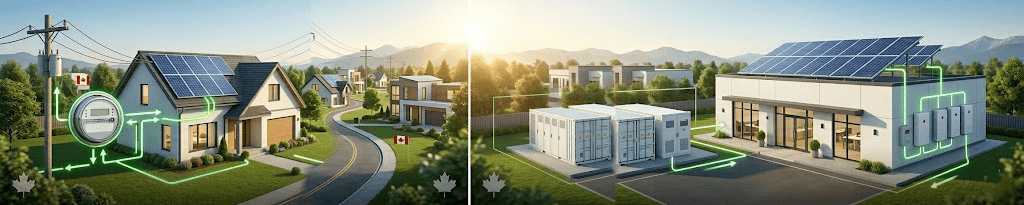
Net Metering VS Behind the Meter: The Canadian Solar Guide
When you begin planning a residential or commercial solar installation anywhere in Canada, you will inevitably run into two terms that sound highly technical but dictate your entire financial outcome: Net Metering and Behind the Meter (often referred to as Load Displacement).
At their core, these terms simply describe what happens to a kilowatt-hour of electricity after the sun hits your solar panels. However, as Canada pushes toward full electrification, choosing between them is no longer just a structural preference, it is a critical compliance decision. Across different provinces, localized utility programs, most famously exemplified by Ontario's Save On Energy Rebate framework, dictate distinct funding rules for each setup. This guide strips away the industry jargon to help Canadian homeowners and businesses choose the right configuration for their energy goals.
What is Net Metering?
Think of a net metering setup as using the central electrical grid as your massive, seasonal battery bank. It is the most common gateway for Canadian homeowners and businesses first entering the renewable energy space.
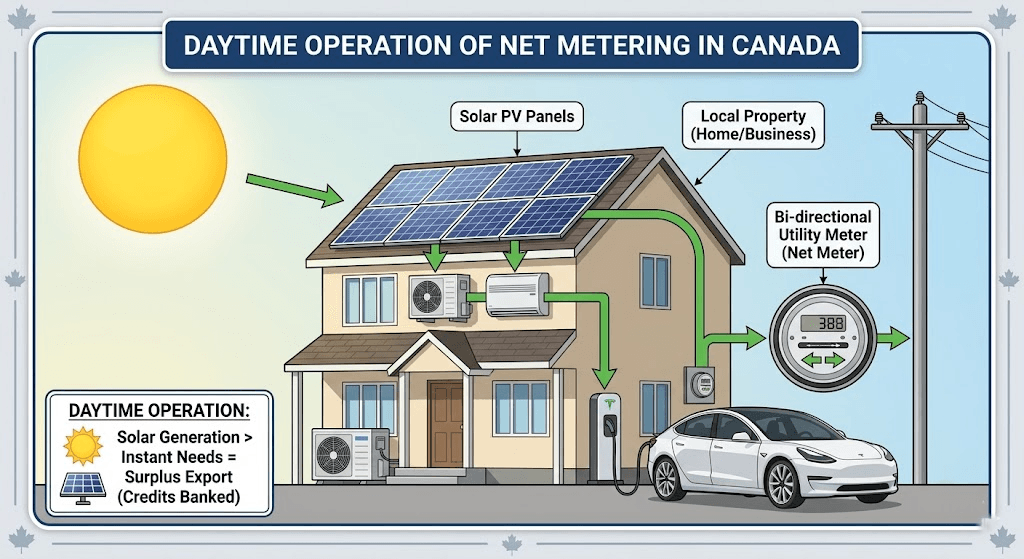
With a traditional grid-tied net metering system, your solar panels power your property in real-time. When the sun is blazing and your solar system produces more electricity than your home or facility can consume, that surplus power doesn’t go to waste. Instead, it flows backward through your utility meter and out into the local provincial power grid.
Your local utility provider (whether it's Hydro One, Enmax, or Nova Scotia Power) tracks this export on a balance-sheet model. They credit your account in kilowatt-hours (kWh) or dollar equivalents. During the night or throughout dark Canadian winter months when your panels are dormant, you pull electricity back from the grid, using up those accumulated credits to drive your net bill down.
The Regional Advantage: In some provinces, grid-tied setups are highly incentivized. For example, in British Columbia, homeowners and business owners can leverage a grid-connected setup to qualify for the lucrative BC Hydro solar rebate. Under this framework, you seamlessly transition into their modern Self-Generation Service Rate (Rate Schedule 2289), which automatically credits you at a flat, stable rate of 10 cents per kWh for all excess power sent back to the grid on each billing cycle.
What is Behind the Meter (Load Displacement)?
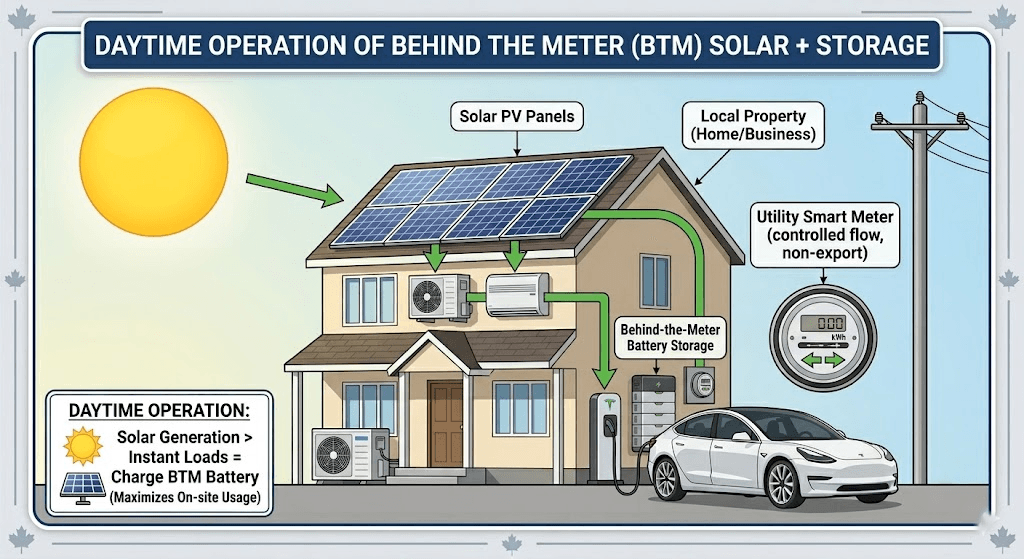
A behind the meter residential or commercial setup behaves like an independent energy island. In this framework, all the clean energy your panels harvest stays strictly on your side of the utility meter, providing true load displacement vs net metering Canada wide.
Because you aren't exporting excess energy back into the public grid for credits, pairing this setup with an intelligent home energy storage system (a localized battery bank or commercial BESS) is practically mandatory to save your excess energy.
Daytime Operation: Your solar array powers your appliances, facility machinery, or heat pumps in real-time. Any surplus power generated during peak sunlight is redirected to charge your battery bank rather than escaping to the grid.
Nighttime/Cloudy Operation: When solar production stops, your property doesn’t immediately jump back onto the utility. Instead, the battery discharges its stored clean energy to run your home or business smoothly.
The Major Incentive Advantage: This configuration is highly favored by strict regional efficiency programs. For example, prominent utilities offering a Save On Energy Rebate or localized energy-saving incentives heavily subsidize behind-the-meter load displacement systems with upfront cash-back grants for both solar panels and battery storage, since they reduce immediate strain on the macro-grid.
Face-to-Face Comparison: Net Metering vs. Behind the Meter
Choosing the optimal path across Canada comes down to analyzing how your local utility charges for power and how your property consumes it.
| Feature | Net Metering (Grid-as-a-Battery) | Behind the Meter (Load Displacement + Battery) |
|---|---|---|
| Rebate & Grant Compatibility | While certain provinces still offer incentives for grid-tied configurations, many provincial funding models are actively shifting their focus to encourage residents to install localized battery storage for grid resilience. | Highly eligible for premier provincial and utility battery-plus-solar grants, as modern rebate structures increasingly prioritize and reward on-site self-consumption. |
| Surplus Energy Management | Exported to the local grid in exchange for utility billing credits. | Kept entirely on-site and saved inside a localized storage bank. |
| Grid Power Independence | Tied directly to utility terms; credits often expire if unused after a rolling 12-month window. | High independence; minimizes real-time exposure to variable utility rates and time-of-use peaks. |
| Blackout/Emergency Backup | ❌ Standard systems shut down during a grid failure to protect utility line workers. | Provides instantaneous backup power to keep essential systems running during blackouts. |
| Best-Fit Profile | Properties with heavy seasonal shifts looking to bank summer sun for winter snow. | Properties facing high peak-demand charges or requiring operational resilience. |
The Commercial Edge: Peak Shaving
For businesses executing a commercial solar installation anywhere from British Columbia to Ontario, behind-the-meter setups offer a massive financial weapon: peak shaving commercial control.
Commercial utility bills across Canada are heavily driven by peak demand charges, steep financial penalties calculated from your highest single window of grid use during the month. By configuring a behind-the-meter battery bank, an intelligent energy management system can detect when your facility is about to hit a massive demand spike and immediately discharge battery power. This keeps your grid draw completely flat, shaving thousands of dollars off your corporate overhead.
Take Control of Your Energy Strategy
The solar decision in Canada is no longer a one-size-fits-all roadmap. If your primary goal is maximizing upfront capital assistance from regional programs like a Save On Energy Rebate and BC Hydro Solar and Battery Incentive achieving blackout protection, and keeping your energy completely localized, a behind-the-meter configuration backed by a solid battery bank is your ideal path. If you want to leverage your roof space to wipe out your winter bills via summer credits without buying heavy battery hardware, traditional net metering remains a lucrative investment.
Unsure which engineering design matches your province's utility framework? Contact our clean energy consultation team today. We will run an advanced load analysis on your utility bills, calculate your exact regional payback metrics, and design the compliant system needed to future-proof your home or business.
[Request Your Free Canadian Solar & Storage Configuration Assessment Now]
Frequently Asked Questions
1. Can I get a Save On Energy or similar provincial solar rebate if I sign a net metering agreement?
It depends heavily on your local jurisdiction, but many prominent efficiency programs (including specific load displacement streams like Ontario's Save On Energy frameworks) require systems to be configured strictly behind-the-meter to qualify for upfront solar-plus-storage cash incentives. Traditional net metering configurations are frequently locked out of these specific load displacement pools.
2. Can I transition a behind-the-meter system into a net metering system later?
While physically possible because the core inverter hardware is similar, doing so retrospectively could breach your original utility funding or rebate agreement, which mandates load displacement. Furthermore, you would have to submit an entirely new connection request to your Local Distribution Company (LDC), which may reject it if the local grid transformer capacity is full. It is highly recommended to choose one dedicated path from day one.
3. Do batteries in a behind-the-meter system store summer energy for winter use across Canada?
No. Stationary battery storage systems are daily cycling tools. They are engineered to store energy generated during the daytime to get you through the evening or consecutive cloudy days. They do not possess the capacity to hold power across several months. If seasonal shifting (banking July sun for January snow) is your primary goal, net metering is the superior option because Canadian utilities track your credits across a rolling 12-month window.
4. Are there nationwide tax advantages that apply to both configurations?
Yes, absolutely! Regardless of whether you select a net metering or a behind-the-meter configuration, commercial operations across Canada can leverage the federal 30% Clean Technology Investment Tax Credit (ITC) and first-year accelerated capital cost write-offs. This significantly eases the capital burden for businesses across all provinces.