Save On Energy Rebate: The 2026 Comprehensive Guide for Heat Pumps, Solar, and Energy Storage
Managing a home or business in Ontario requires a proactive defense against rising utility bills. Between fluctuating heating costs in the winter and steep peak-demand surcharges in the summer, structural energy efficiency is no longer just a sustainability goal, it is a core financial strategy.
Fortunately, the province's incentive frameworks have evolved to meet this challenge. Under the banner of the Save On Energy Rebate ecosystem, the government and utility providers have overhauled their offerings for 2026. Whether you are looking to install a cold-climate heat pump in your home, add a solar array to your roof, or future-proof a commercial facility, this guide provides the definitive blueprint to maximize your upfront savings and long-term return on investment (ROI).
The Trend of Energy Saving by Using Solar, Battery, and Heat Pump in Ontario
Ontario’s energy landscape is undergoing a massive shift toward holistic, decentralized ecosystem management. Historically, homeowners and businesses tackled utility bills in silos, upgrading an appliance here or adding a bit of insulation there. However, a combination of climbing electricity rates, the introduction of Ultra-Low Overnight (ULO) pricing structures, and climate-driven grid stress has sparked a new era of self-sufficiency.
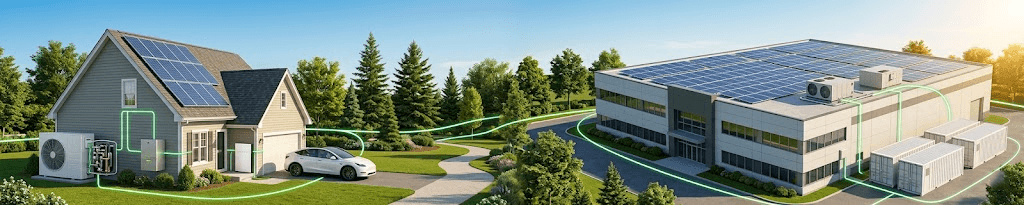
In 2026, the dominant trend has evolved into a "triple-threat" energy-saving strategy: seamlessly combining cold-climate heat pumps, rooftop solar generation, and battery storage into a single, high-performance loop.
Rather than relying entirely on the macro-grid for volatile heating and power demands, forward-thinking property owners are deploying these technologies to complement one another perfectly:
Thermal Efficiency via Heat Pumps: High-efficiency heat pumps drastically lower a building’s primary energy demand. Because they move heat rather than creating it, they replace inefficient fossil fuels or old electric baseboards, instantly shrinking the building's baseline power consumption.
Zero-Emission Offsets via Solar: Rooftop solar installations in Ontario capture clean electricity during peak daylight hours. This free, self-generated power is routed directly to run the heat pump, essentially heating and cooling the property for free during the day.
Load Control via Battery Storage: A home solar battery or commercial storage bank (BESS) acts as the brain of the ecosystem. It captures excess daytime solar generation or draws cheap power from the grid overnight. The battery then discharges that stored energy during expensive peak afternoon windows to keep the heat pump running without drawing premium-priced electricity from the grid.
By unifying these three pillars, Ontarians are capitalizing on stacked Save On Energy Rebate opportunities, insulating themselves from grid instability, and systematically driving their net energy consumption, and monthly utility bills, down toward absolute zero.
What Is the Save On Energy Rebate?
The phrase "Save On Energy Rebate" represents a collection of provincial conservation programs designed to lower the upfront capital barriers of clean technology.
For residential spaces, Save on Energy and Enbridge Gas, supported directly by the Ontario government, have launched the Home Renovation Savings Program (HRSP). This serves as the primary gateway for residential upgrades, offering two flexible paths: a "Bundled Path" (requiring pre- and post-retrofit energy audits to complete multiple upgrades) and a simplified "Single Upgrade" path for rapid, standalone system additions.
For commercial, industrial, institutional, and multi-family structures, incentives are distributed through the long-running Save on Energy Retrofit Program. This program rewards enterprises that reduce their grid load with structured, performance-based cash rebates.
Rebate Breakdown: Residential vs. Commercial Payouts
Because these programs adjust periodically to balance demand and ratepayer cost-effectiveness, keeping a close eye on active funding criteria is essential. Here is where the numbers sit:
1. Residential Properties (Home Renovation Savings Program)
Homeowners can leverage aggressive cash-back options, with separate tracks designed to match different project scales:
Cold-Climate Air-Source Heat Pumps: Up to $7,500 in rebates, varying based on system size, specific model selection, and your current heating fuel type.
Ground-Source (Geothermal) Heat Pumps: Up to $12,000 for deep thermal retrofits.
Solar Panels & Battery Storage: Up to $10,000 total under the program's single-upgrade stream. This allows you to claim separate caps for generation and storage equipment without completing a full home energy assessment.
2. Commercial Buildings (Save on Energy Retrofit Program)
Commercial operators can offset up to 50% of eligible project costs. However, a major structural adjustment is taking effect mid-year:
The Commercial Solar Rebate Drop: For rooftop solar installations over 10 kW (up to 1 MW AC), the prescriptive rebate drops by 10% on June 30, 2026, falling from $860 per kW AC down to $770 per kW AC. Smaller microgeneration systems up to 10 kW DC are unaffected and remain steady at $1,000 per kW DC.
Custom Non-Lighting Increases: To balance the solar drop, the IESO has increased custom non-lighting measure incentives (such as massive central mechanical and complex building controls) to an elevated $1,800/kW and $0.20/kWh.
The Grandfathering Rule: Complete commercial solar applications submitted to the portal before June 30, 2026, are fully locked in and honored at the original, higher $860/kW AC rate. If you are planning a commercial solar build, filing your paperwork early is vital.
Strategic Reasons to Switch to a Heat Pump
Traditional heating systems like oil, propane, or older electric baseboard heaters are remarkably inefficient and highly vulnerable to fuel price shocks. Upgrading to a cold-climate air-source heat pump delivers immediate operational advantages:
Unmatched Efficiency: Modern cold-climate heat pumps can operate at up to 300% to 400% efficiency, meaning they deliver three to four times more heat energy than the electrical energy they consume.
Hybrid Dual-Fuel Comfort: While modern cold-climate heat pumps are incredibly resilient, pairing a heat pump with a high-efficiency furnace creates the ultimate hybrid system for Canada's harsh winter weather. In this dual-fuel configuration, the heat pump handles all your central cooling in the summer and efficiently manages heating on moderately cold days. When temperatures drop into extreme sub-zero snaps, your furnace seamlessly kicks in as a powerful backup. This tag-team approach keeps your home perfectly warm year-round while dramatically optimizing your utility bills.
Carbon and Maintenance Reductions: Eliminating on-site fossil fuel combustion drastically drops your building's direct carbon footprint while removing the combustion risks and frequent maintenance hassles associated with conventional oil or gas burners.
Why Go Solar in Ontario?
Utility Price Protection: Hydro rates are heavily prone to long-term inflation. Generating your own clean electricity establishes a fixed, predictable energy cost curve for decades to come.
Behind-the-Meter (BTM) Rebate Eligibility: To qualify for a Save On Energy Rebate to help offset your installation costs, your solar and battery system must be configured as a behind-the-meter (BTM) setup. This means the electricity you generate is used directly on-site to power your property's immediate needs, directly lowering what you draw from the utility. While you can still choose to install a traditional grid-tied net metering system to bank credits for summer surplus, opting for that route means forfeiting the upfront provincial rebate entirely. Focusing on a smart behind-the-meter design is the only way to secure the cash-back incentive while maximizing self-consumption.
Aggressive Tax Optimization: Commercial enterprises can systematically combine their provincial rebates with the Federal 30% Clean Technology Investment Tax Credit (ITC) and first-year accelerated depreciation, compressing traditional solar paybacks to just 5 to 8 years on a 30-year asset.
The Power of Resilience: Why You Should Add a Battery
Peak Shaving and Surcharge Avoidance: For commercial entities and Class A industrial customers, peak demand charges can represent up to 70% of a monthly power bill. A BESS allows you to "peak shave", automatically switching your facility to internal battery power during expensive, high-demand grid peaks to avoid crossing costly thresholds.
Energy Arbitrage: Under variable time-of-use pricing, electricity is significantly cheaper overnight. You can program your battery to draw cheap power from the grid during off-peak hours (or save free solar power during the day) and discharge it during expensive peak afternoon windows.
Absolute Grid Blackout Protection: Severe windstorms, heavy winter ice, and grid overloads bring a continuous risk of power outages. A battery backup system acts as an instantaneous safety net, keeping critical electronics, server rooms, assembly lines, and refrigeration units fully online.
Take Charge of Your Energy Bills Today
The era of passive energy consumption is closing. Ontario households and businesses that take a proactive stance on self-generation and thermal upgrades will systematically isolate themselves from volatile operating costs. Because program rules, equipment lists, and commercial solar funding pools change frequently based on high application volumes, acting early is vital to secure your maximum funding allotment.
Ready to claim your rebate? Contact our engineering group today to get a custom solar, battery, or heat pump feasibility assessment, calculate your projected ROI, and let our compliance team handle your application to secure the highest active 2026 rebate rates.
[Request Your Free Clean Energy Assessment and Rebate Consultation]
Frequently Asked Questions (FAQs)
1. Do I need a home energy audit to claim the residential heat pump rebate?
No. If you are applying solely for an individual heat pump, heat pump water heater, or a smart thermostat under the single-upgrade track of the Home Renovation Savings Program, a pre- and post-retrofit home energy assessment is completely optional. However, if you want to bundle your heat pump with insulation or window upgrades for maximum savings, you must complete both audits before any structural work begins.
2. Can commercial properties stack the Save on Energy rebate with federal tax credits?
Yes, absolutely. Taxable Canadian corporations can stack their provincial Retrofit Program rebates with the Federal 30% Clean Technology Investment Tax Credit (ITC). Note that the federal ITC is calculated based on the net capital cost (the total cost of the system minus the provincial grant value), making stacked financing the optimal way to maximize your project's overall return on investment.
3. What happens if my commercial solar application is submitted on June 29, 2026?
As long as your application is completely filled out and successfully submitted to the Save on Energy portal before the June 30, 2026 deadline, your project is safely grandfathered and will be honored at the original, higher rate of $860 per kW AC. Applications submitted on or after June 30 will automatically be subject to the lower $770 per kW AC incentive tier.
4. Do heat pumps actually work well during cold Ontario winters?
Yes, modern cold-climate air-source heat pumps are highly advanced and engineered to extract ambient heat from the outside air even down to -25°C or -30°C. However, given Canada’s notoriously harsh winter weather and deep-freeze cold snaps, we highly encourage homeowners to install a hybrid dual-fuel system.
By pairing a cold-climate heat pump with a high-efficiency gas, propane, or oil furnace, you get the absolute best of both worlds. The heat pump efficiently manages your home's heating during moderately cold winter days and handles all your cooling in the summer. When temperatures plummet into an extreme Ontario deep-freeze, your furnace automatically takes over to provide heavy-duty backup warmth. This tag-team configuration ensures your home remains perfectly comfortable no matter how brutal the weather gets outside, all while optimizing your Save On Energy Rebate potential and minimizing your monthly utility bills.