British Columbia Solar Guide 2026: The Definitive Residential and Commercial Blueprint
British Columbia's energy framework is undergoing its most massive structural re-engineering in a generation. Long celebrated for its abundant hydroelectric power, the province is experiencing unprecedented electricity demand driven by wide-scale electrification and rapid economic growth.
The playbook for deploying solar panels in the province has changed completely this year. Driven by landmark regulatory updates by the B.C. Utilities Commission (BCUC), the financial blueprint for going solar has evolved from simple energy banking into a modern, production-focused system. With baseline utility rates rising, taking control of your clean generation is no longer an environmental statement, it is a critical economic strategy.
This comprehensive British Columbia Solar Guide 2026 outlines the exact regulatory changes, financial programs, and technical configurations needed to optimize residential and commercial systems under the new provincial framework.
The Trend of Solar in British Columbia
Solar adoption across BC is pacing at historic highs, moving decisively into mainstream territory. Over 17,000 properties have deployed customer-generation systems across the province under BC Hydro, with the vast majority utilizing high-performance rooftop solar photovoltaic (PV) system.
The single biggest trend defining 2026 is the rapid rise of integrated solar-plus-storage systems. Rather than deploying standalone solar panels, BC homeowners and commercial property operators are actively installing smart battery storage systems. This behavioral shift is directly incentivized by BC Hydro's structural rate updates, which reward localized storage to help flatten grid demand and provide robust backup power during seasonal winter storms and maritime weather anomalies.
Furthermore, BC's commitment to clean energy remains solid, backed by the province's strict clean-tech rules and aggressive municipal climate programs. Private solar installer incentives and modern financing models are stepping in to lower upfront hurdles, making the path to energy autonomy highly accessible.
Net Metering vs. Behind-the-Meter in British Columbia
How your project connects to the utility grid will determine your long-term return on investment. The defining catalyst for this layout is BC Hydro’s major shift in customer-generation compensation.
1. The New Grid Model: BC Hydro Self-Generation
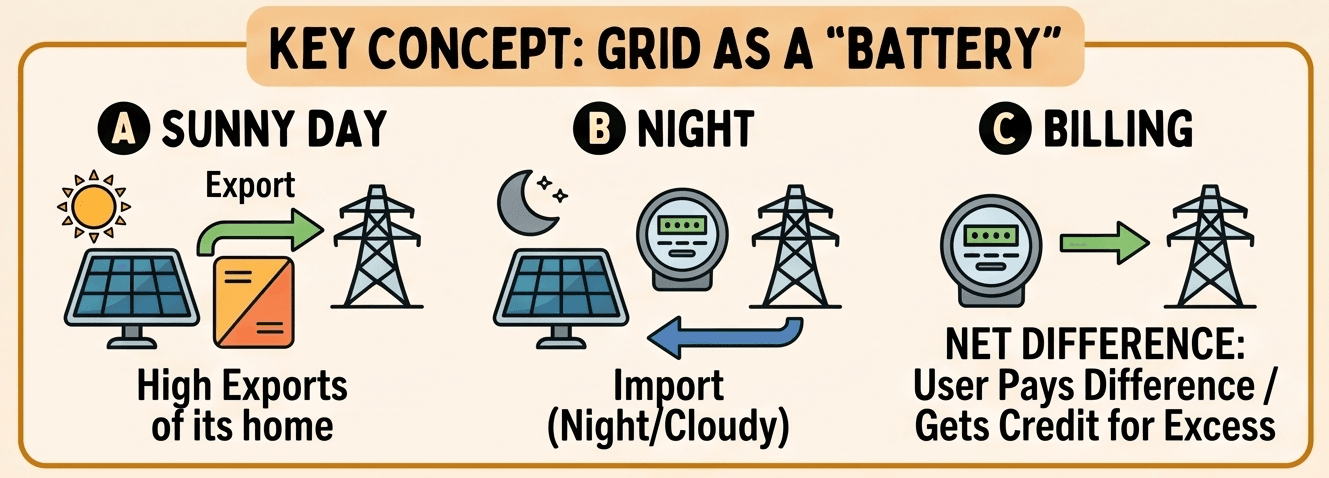
Historically, BC Hydro operated a standard net metering program under Rate Schedule 1289, which allowed users to bank surplus power as a kilowatt-hour credit to offset future consumption.
The Major 2026 Shift: Effective July 1, 2026, the legacy net metering rate is permanently closed to new applicants. In its place, BC Hydro has rolled out the new Self-generation service rate (Rate Schedule 2289).
The Mechanism: Under Rate Schedule 2289, you are encouraged to build larger systems to self-supply a major portion of your own energy needs. If your panels export surplus power back to the grid (up to 100 kW per phase), BC Hydro no longer banks it as a credit; instead, they purchase it directly by paying you a fixed cash rate of 10 cents per kWh.
Grandfathering Rules: Legacy customers on Rate Schedule 1289 have up to 10 years from their initial start date to remain on the old banking system before automatically transitioning to the new 2289 self-generation rate. However, note that if you take advantage of BC Hydro's active solar rebates, you will automatically transition to the new 10-cent self-generation rate as of July 1, 2026.
2. Behind-the-Meter (BTM) Load Displacement
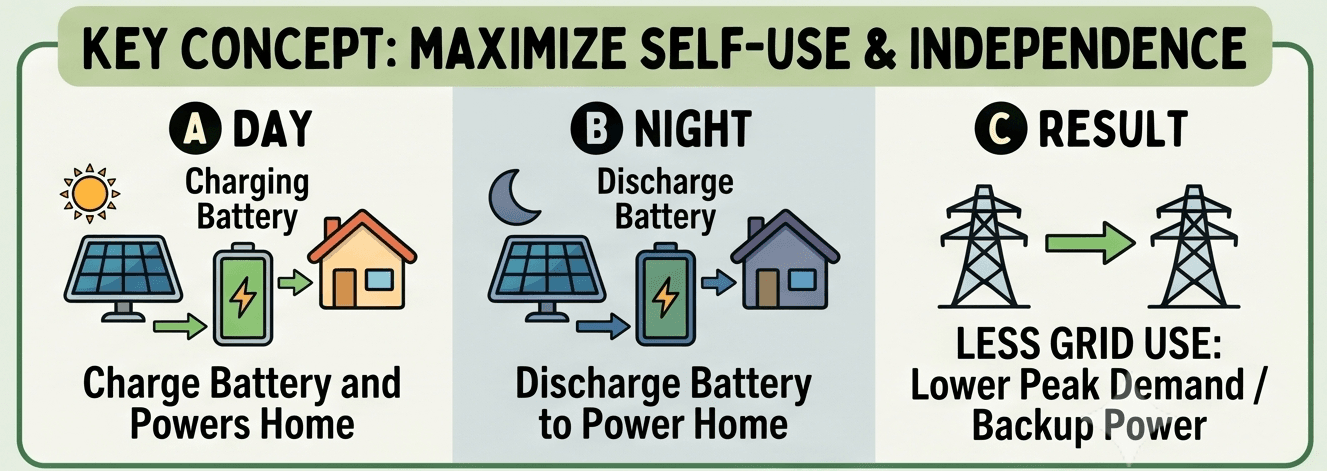
For properties seeking true utility isolation, a Behind-the-Meter (BTM) setup paired with local energy storage is an exceptional pathway.
The Mechanism: All power generated by your array is completely consumed on-site or channeled to charge high-capacity batteries. The system is engineered so that zero clean electricity overflows into the public utility grid.
The Advantage: A non-exporting BTM system allows you to aviod the utility's peak demand hours. By charging batteries via the grid during cheap overnight periods or directly using daytime solar, you insulate your facility from peak surcharges. For coastal businesses and rural properties prone to seasonal storms, BTM delivers critical emergency backup and maximum energy resilience.
Residential and Commercial Rebate Structures
To support the transition to the new self-generation rate, the province has deployed highly lucrative cash-back incentives. However, the operational rules tightened mid-year, demanding strategic project alignment.
The HPCN Requirement Update
Crucial 2026 Rule: All residential and commercial solar and battery systems must be entirely designed and installed by a certified Home Performance Contractor Network (HPCN) member to qualify for any BC Hydro solar and battery rebates. Self-installations or projects executed by non-registered contractors are locked out of all public funding.
Residential and Commercial Rebate Breakdown
BC Hydro provides generous funding for grid-connected projects up to an aggregate capacity of 100 kW. The rebate parameters depend heavily on property classification and battery deployment:
1. Solar Photovoltaic (PV) Rebates
The prescriptive rebate provides $1,000 per kW of installed DC generator capacity, capped at a maximum of 50% of total product and installation costs up to the following caps:
Residential Dwellings (Individually Metered): Capped at a maximum of $5,000.
Commercial or Multi-Unit Residential Buildings (MURBs): Capped at a maximum of $10,000.
Social Housing, Indigenous Communities, & Remote Microgrids: Expanded funding up to a maximum of $50,000.
** 2.** Battery Energy Storage System (BESS) Rebates
To receive the battery grant, systems must have a minimum capacity of 5 kWh and be paired with solar generation. The incentive pays $500 per kWh of capacity, capped at 50% of eligible costs up to these limits:
Standard Residential: Capped at $1,500.
Residential Enrolled in the Peak Saver Program: Capped at an elevated $5,000.
Commercial or Multi-Unit Buildings: Capped at a maximum of $10,000.
Social Housing, Indigenous, and Remote Communities: Capped at an exceptional $50,000.
The Commercial Edge: Deep Federal Tax Credits
If you are deploying a commercial solar installation in BC wide, you can stack the provincial BC Hydro business rebate with powerful federal clean energy tax provisions:
The Federal 30% Clean Technology ITC: Canadian corporations qualify for a 30% refundable investment tax credit on the total capital equipment costs of the solar and BESS asset. Because it is a refundable tax credit, the CRA will issue a direct refund check if your business owes no corporate income tax that fiscal year.
Accelerated Capital Cost Allowance (CCA): Under Class 43.1 and 43.2, commercial entities can claim a 100% depreciation write-off in the very first year of operation, drastically lowering immediate corporate income tax liabilities.
Secure Your Energy Autonomy
The structural adjustments of 2026 make clear one fundamental truth: the sooner you deploy solar and battery assets under the guidance of certified experts, the more effectively you insulate your pocketbook from future grid fluctuations. By combining BC Hydro’s solar and battery incentives or federal corporate tax reliefs, you can transform your property into a highly efficient cost-saving machine.
Don't navigate the complex HPCN and interconnection network alone. Contact our local British Columbia engineering team today for a free virtual site assessment, custom system layout, and complete assistance in fast-tracking your grid applications before seasonal slots close.
[Request Your Free British Columbia Solar & Energy Assessment Now]
People Also Ask
1. What are the specific timelines for the BC Hydro net metering updates 2026?
The legacy net metering program (Rate Schedule 1289) officially closed to new applicants on July 1, 2026. On this same date, the new Self-generation service rate (Rate Schedule 2289) took full effect. Existing net-metering customers are grandfathered for 10 years from their original interconnection start date before shifting to the new self-generation rate.
2. Can I install solar panels myself and still claim the BC Hydro solar rebate?
No. Under the updated regulatory requirements, self-installed systems are completely ineligible for rebates. To successfully claim up to $5,000 for solar panels and $1,600 for batteries, your entire system must be designed and physically deployed by an authorized member of the Home Performance Contractor Network (HPCN).
3. How does the "Peak Saver" program affect my battery storage rebate?
Enrolling your home energy storage system in BC Hydro's Peak Saver demand-response initiative unlocks a major funding boost. While standard residential battery installations are capped at a $1,500 rebate, enrolling your eligible battery in Peak Saver increases your maximum battery storage rebate up to $5,000.
4. What happens to my excess solar generation under the new Rate Schedule 2289?
Instead of banking energy as credit hours to use later, any surplus electricity your solar system feeds back into the utility grid is purchased directly by BC Hydro. Under the self-generation service rate, you will be compensated at a fixed, uniform rate of 10 cents per kWh for all net energy injections up to 100 kW per phase.
5. Are commercial properties outside BC Hydro’s territory eligible for these solar rebates?
The direct solar and battery cash rebates detailed in this guide are funded by BC Hydro and are strictly available to active account holders within BC Hydro's service territory and the City of New Westminster Electric Utility (NWEU). Customers served by other provincial utilities, such as FortisBC, do not qualify for these specific offers but businesses can still leverage the federal 30% Clean Technology ITC and first-year accelerated tax write-offs.