The Future of Sustainable Living: A Guide to Net Zero Homes
When you think about the ultimate residential living experience, what comes to mind? For many modern homeowners, the goal is a space that is incredibly comfortable, environmentally responsible, and free from the constant stress of rising utility bills. This is where net-zero homes come into the spotlight.
As energy costs fluctuate and extreme weather becomes a more frequent reality, the shift toward sustainable housing is no longer just an industry trend—it is becoming the new standard in residential construction and deep home renovations.
What is a Net Zero Home?
At its core, a net zero home is a highly efficient residence designed to produce as much clean energy as it consumes over the course of a full year. According to efficiency authorities like Save on Energy in Ontario, these properties are up to 80 percent more energy-efficient than typical houses built to minimum standard building codes.
The secret to net zero energy homes isn’t just slapping a few solar panels on the roof; it requires a holistic, "envelope-first" approach. This means the house is exceptionally well-insulated and airtight, drastically reducing its initial energy demand.
You might also come across the term net zero ready. This refers to a house that is built to the exact same rigorous efficiency standards but does not yet have the renewable generation systems (like solar) installed. It is essentially wired and ready to achieve full net zero status whenever the homeowner is ready to make the final investment.
Furthermore, you do not have to live off-grid. Most net zero builds are grid-tied. This allows you to draw power during the darker days of winter and push excess solar energy back to the grid during sunny summer months through a process called net metering.
The Incredible Benefits of Net Zero Living
Moving into a net zero home transforms how you experience your daily environment. Beyond the obvious environmental perks of a smaller carbon footprint, the advantages are deeply personal and financial:
- Exceptional Comfort: Thanks to advanced insulation and airtightness, you will not experience cold drafts, uneven room temperatures, or uncomfortable chills near windows.
- Lower Utility Costs: With a net-zero home, your net electricity consumption over the year balances out, buffering you against future utility rate hikes.
- Healthier Indoor Air Quality: A tightly sealed home requires intelligent mechanical ventilation. This system constantly filters out dust, allergens, and outdoor pollutants before circulating fresh air inside.
- Quiet Interiors: The thick walls and heavy windows required for a high-performance building envelope act as incredible soundproofing, virtually silencing traffic and neighborhood noise.
- Weather Resilience: During extreme heatwaves or winter power outages, net zero homes maintain safe, livable indoor temperatures for significantly longer periods than conventional homes.
What Products and Technologies Power a Net Zero Home?
Achieving net zero status is made possible by combining several advanced, high-efficiency technologies:
- The Building Envelope: This is the foundation of the home. It includes continuous exterior insulation, meticulous air-sealing, and high-performance double- or triple-pane windows strategically placed to take advantage of passive heating from the winter sun.
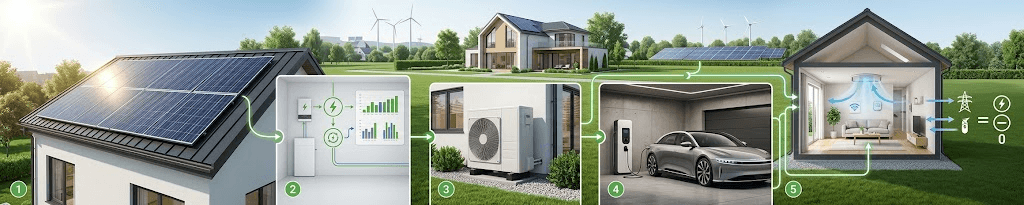
- Cold-Climate Heat Pumps: Replacing traditional natural gas furnaces, modern air-source or ground-source heat pumps efficiently provide both heating and cooling—even during deep winter freezes.
- Energy Recovery Ventilators (ERV): Because the home is built so tightly, an energy recovery ventilator (ERV) or heat recovery ventilator (HRV) is installed to continuously swap stale indoor air with fresh outdoor air. It recovers the thermal energy from the outgoing air, ensuring no heat is wasted.
- Solar Photovoltaic (PV) Panels: This is the generation engine. Once the home’s energy needs are minimized, an appropriately sized rooftop solar array generates the clean power required to run the house.
- EV Charging Integration: Modern net-zero builds look to the future by including high-capacity electrical panels and conduit runs for Electric Vehicle (EV) chargers, allowing you to power your car with the clean energy generated right on your roof.
- Heat Pump Water Heaters: These highly efficient units pull warmth from the surrounding indoor air to heat your domestic water, using a mere fraction of the electricity required by a conventional hot water tank.
What We Experience When We Achieve a Net Zero Home
When you step into a fully realized net zero space, the most striking feature is what you do not notice. You don't hear the wind howling outside. You don't feel a sudden, noisy blast of hot air when a furnace kicks in because the temperature remains perfectly consistent. And perhaps most satisfyingly, you do not feel anxiety when opening your monthly utility bill.
Sustainable living at this level delivers ultimate peace of mind. You know that your living space is self-sufficient, durable, and actively contributing to a greener future without compromising on modern luxury or architectural beauty.
Whether you are planning a custom new build or considering a deep energy retrofit for your current property, taking the first step is easier than you think. Contact a certified energy advisor or an experienced custom home builder today to schedule a professional energy assessment and discover how you can transform your property into a high-performance net zero home.
People Also Ask
1. Can I renovate my existing house to be a net zero home?
Yes! While building a custom home from scratch gives you maximum control over the home's orientation and geometry, existing houses can undergo deep energy retrofits to achieve net zero status. This typically involves adding exterior insulation, upgrading windows, rigorous air-sealing, switching to an electric heat pump, and installing solar panels.
2. Do I need large battery banks to run a net zero home?
No, batteries are not a requirement. The vast majority of net zero homes remain grid-tied, meaning they use the municipal utility grid as a virtual battery—exporting excess power during the day and drawing from the grid at night. However, adding a small battery can provide excellent backup resilience for critical circuits during local power outages.
3. Is the net zero home cost significantly higher than a standard build?
While the upfront net zero home cost is generally higher than building a conventional, code-minimum house, the financial gap is shrinking as technologies improve. The potential for government energy efficiency rebates and the long-term return on investment make it a highly sensible financial decision.
4. Do cold-climate heat pumps really work in freezing Canadian winters?
Absolutely. When correctly sized and paired with a tight, well-insulated building envelope, modern cold-climate heat pumps can easily and efficiently heat homes even when outdoor temperatures plummet into deep freezing ranges.