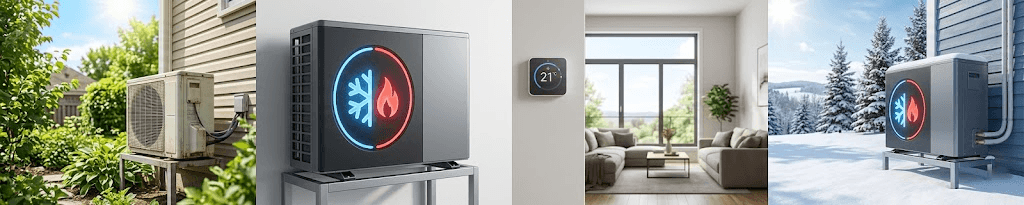
Should I Replace My AC with a Heat Pump? Your 2026 Ontario Guide
As an organization dedicated to helping Canadian households reduce electricity costs and embrace sustainable innovation, the Electricity Council of Canada (ECC) has created this strategic guide. We will walk you through the signs of a failing cooling system, the robust financial incentives available in 2026, and the critical reality-check factors to consider before you switch.
Signs Your AC Needs to Be Replaced
Your cooling system usually lets you know when it’s nearing the end of its line. If you are experiencing any of these signs, investing in a repair might just be throwing good money after bad.
- Its Birthday Has Came and Gone: Central AC units typically last 15 to 20 years. If your unit is pushing past the 15-year mark, its internal components are likely inefficient, nearing failure, and use outdated refrigerants that are becoming expensive to replace.
- The Repair Bills are Escalating: It’s called the "repair ratchet." If you are calling a technician every spring just to get the unit started, or if a single repair estimate exceeds 50% of the cost of a new unit, it's time to replace the air conditioner.
- Temperature Tantrums: One room is a meat locker, the next is a sauna. A healthy cooling system provides consistent, smooth comfort. Wild temperature swings across different rooms mean the compressor is failing or the system can no longer manage the load.
- Utility Bill Shock: Are your hydro bills spiking every summer despite your usage habits staying the same? Inefficient motors and clogged components in an older unit draw significantly more power to achieve less cooling.
Why Replace Your AC with a Heat Pump?
If you decide to retire your old AC, you should seriously consider upgrading to a cold-climate heat pump. While the name "heat pump" can be misleading, this is a sophisticated, all-in-one appliance that does two crucial jobs.
2-in-1 System: Heating and Cooling
The primary benefit of a heat pump is that it replaces two aging appliances.
- In the summer, it functions exactly like your traditional AC, extracting heat from your house and moving it outside to keep you cool.
- In the winter, a simple valve reverses the process. It extracts thermal energy from the cold outside air and pumps it inside to heat your home.
This means you replace two maintenance-heavy systems (your old AC and your outdated furnace or boiler) with a single, sleek, low-maintenance unit.
Unmatched Energy Efficiency
Heat pumps do not create heat; they simply move it. Traditional furnaces burn fuel (natural gas, oil) to generate heat. Even highly efficient gas furnaces can only reach about 98% efficiency.
Modern air source heat pumps are over 300% efficient at mild temperatures. They deliver more energy than they consume. Furthermore, cold-climate heat pumps are now certified to operate efficiently down to sub-zero temperatures as low as -30°C.
Significant Ontario Heat Pump Rebates
In 2026, the strategy of "electrification" means major financial programs are active to lower the entry cost for Ontarians. While the federal grant programs have evolved, provincial and utility-backed incentives are aggressive.
- Ontario Heat Pump Rebate (2026): Through the current Home Renovation Savings Program, Ontario homeowners can qualify for significant rebates—up to $7,500 forccASHP certified, cold-climate air-source systems, depending on your primary heating fuel.
Factors to Consider Before Switching
Switching to a heat pump is a smart financial move, but it is not a "plug-and-play" installation. It requires an expert, holistic assessment of your home's infrastructure.
Hybrid Systems: Keep Your Best Parts
If you already have a relatively new, high-efficiency gas furnace, you don't necessarily have to toss it. A very popular and profitable option is installing a hybrid (dual-fuel) system.
In this setup, your heat pump handles the heating and cooling during the milder, transitional temperatures of autumn and spring. Your furnace automatically kicks in during those deep polar vortex freezes, keeping utility bills optimized while ensuring reliable comfort on the coldest nights.
Electrical Upgrades
Modern heat pumps typically require a robust electrical connection, often calling for a 200-amp electrical panel. Many older homes still utilize a 100-amp panel that cannot handle the additional load of ccASHP technology.
Before installing, you must factor in the cost of a panel upgrade. Consult an FSR-certified installer to determine your home’s electrical capacity.
Upfront Costs vs. Long-Term Savings
Let’s be human about the reality check: the upfront hardware and installation cost of a cold-climate heat pump is generally higher than a traditional central AC. A heat pump is a massive, highly engineered technical investment. However, the question is not what it costs today; it’s what it saves you over its 20-year lifespan. Through reduced utility bills and stacked Ontario heat pump rebates, the payback period is often shorter than most homeowners expect. You are trading higher upfront investment for significantly lower monthly overhead for the next two decades.
Is a Heap Pump Worth?
In 2026, repairing an aging AC is rarely the best path forward. The convergence of climate goals, high electricity rates, and high-value financial programs makes switching to a cold-climate heat pump the smartest energy decision for the modern Ontario household.
Ready to future-proof your comfort? ECC helps you run the custom math on your home to see if a hybrid system or a full switch will deliver the best return on investment. Request a free consultation now.
Frequently Asked Questions
1. Do I need to throw away my furnace to install a heat pump? No. You can keep a functional gas furnace and set up a hybrid (dual-fuel) system. The heat pump handles heating and cooling during mild seasons, and your furnace automatically takes over as a backup during extreme sub-zero deep freezes.
2. Is a home energy audit required for the Ontario rebate? No. Standalone heat pump installations under the Home Renovation Savings Program do not require an upfront energy assessment. However, pre-approval is mandatory. Your registered contractor must get application approval before any installation work begins, or the rebate will be denied.
3. Can a cold-climate heat pump actually handle Ontario winters? Yes. Modern cold-climate air-source heat pumps (ccASHP) are specifically engineered for Canadian climates. They use variable-speed compressors to efficiently extract thermal energy from the outdoor air at temperatures as low as -30°C.