Powering Production: How Solar and Battery Systems Transform Industrial Manufacturing
Industrial manufacturing facilities—from automotive assembly plants and plastics fabricators to food processing plants and heavy machinery shops—operate in an intensely competitive global market. Success hinges on controlling operational expenses, maintaining continuous production schedules, and meeting strict customer delivery timelines.
However, energy management has become one of the greatest operational headwinds for modern factory managers. Integrating solar and battery storage for manufacturing facilities addresses this challenge directly, turning electricity from an unpredictable overhead cost into a controlled, high-yield asset.
What Industrial Manufacturers Are Facing
Modern factories require massive amounts of electrical power to run heavy machinery, compressed air systems, industrial chillers, and automated assembly lines. Manufacturing operations encounter three major utility challenges:
1. Escalating Grid Electricity Tariffs
Commercial and industrial electricity rates across Canadian utility providers are steadily climbing. As grid operators pass down infrastructure upgrade costs, base energy fees accumulate rapidly for high-consumption industrial facilities operating on multi-shift schedules.
2. Punishing Commercial Demand Charges
For most plants, the volume of energy consumed (kWh) is only part of the monthly bill. Utilities levy a heavy commercial demand charge based on the highest 15-minute power draw recorded during a billing period. When heavy-duty motors, electric arc furnaces, or high-tonnage stamping presses start simultaneously, they create intense peak load spikes. Demand charges frequently account for 30% to over 50% of a manufacturing facility's total monthly electric bill.
3. Production Losses from Micro-Outages and Voltage Sags
Grid instability, weather-related sags, and brief blackouts pose severe biological and mechanical risks. Even a momentary micro-outage can trip sensitive Programmable Logic Controllers (PLCs), jam automated conveyors, spoil temperature-sensitive raw materials, and force hours of expensive equipment recalibration and safety resets.
Why Solar and Battery Systems Help
Combining high-efficiency solar arrays with a commercial-grade Battery Energy Storage System (BESS) provides a multi-layered solution tailored to industrial power demands.
1. Substantial Base Load Reduction
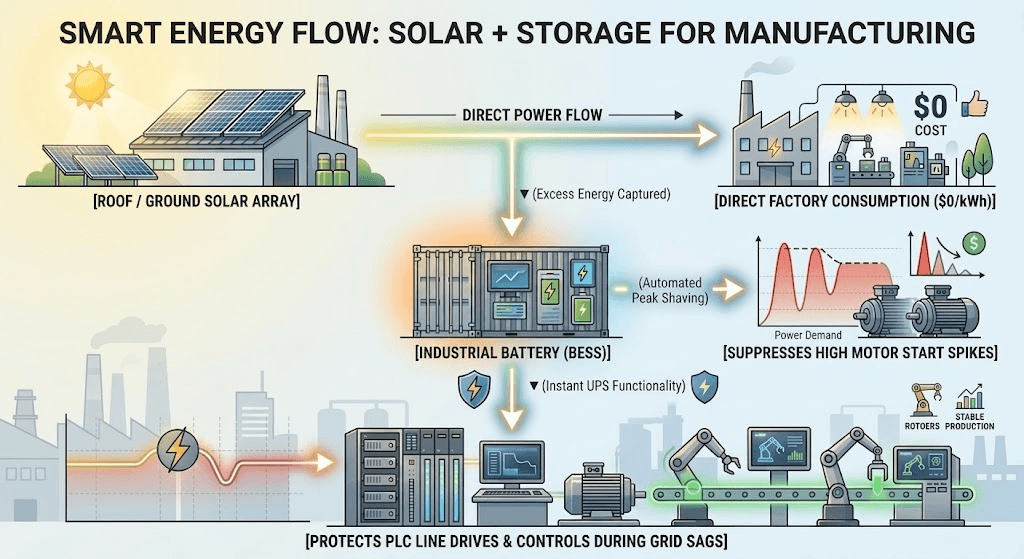
A custom-engineered solar array converts daylight into clean, on-site electricity. By powering baseline lighting, HVAC, auxiliary pumps, and office loads directly from the sun, manufacturers reduce total grid dependence and insulate operations from rising electricity rates.
2. Automated Industrial Peak Shaving
A standalone solar array cannot guarantee demand charge reductions because generation depends on weather conditions. Integrating BESS for industrial facilities unlocks industrial solar peak shaving. The intelligent battery system monitors plant power draw in real time. The moment grid demand approaches a designated threshold during heavy machinery startups, the battery instantly discharges stored energy to absorb the spike—reducing high demand penalties before the utility meter records them.
3. Instantaneous Power Resilience
Modern commercial BESS units double as high-capacity Uninterruptible Power Supplies (UPS). If a local transformer fails or lightning causes a voltage sag, the battery bridges the gap in milliseconds, keeping critical control systems, safety circuits, and automated lines operational.
4. Supply Chain Decarbonization & ESG Compliance
Tier-1 industrial suppliers increasingly face strict Environmental, Social, and Governance (ESG) audit requirements from global corporate buyers. Generating clean power on-site delivers measurable, auditable reductions in Scope 2 carbon emissions.
Provincial Rebates and Federal Incentives for Manufacturers
Canadian industrial enterprises can stack federal tax mechanisms with localized provincial funding streams to maximize financial return on investment.
Provincial Commercial Incentives Breakdown
| Province | Primary Incentive Program | Eligible Scope | Financial Value |
|---|---|---|---|
| Ontario | Save on Energy Retrofit Program | Behind-the-meter load displacement solar & non-exporting BESS | Direct capacity incentives up to $770 per kW AC for eligible non-exporting systems. |
| British Columbia | BC Hydro Business Solar Rebate | Commercial & industrial manufacturing properties | Cash-back rebates up to $10,000 for solar and $10,000 for BESS |
| Alberta | Clean Energy Improvement Program (CEIP) & Emissions Reduction Alberta Capital Retrofits | Industrial facilities in participating municipalities | Low-interest, $0-down property-tax financing up to $1M+, stackable with SEMI retrofit rebate up to $250,000. (*New applications will be placed on waitlist) |
| Nova Scotia | Commercial Net Metering | Manufacturing plants & industrial processing sites | 1:1 net metering utility credits for exported surplus, plus municipal property tax financing. |
Federal Tax Incentives (Applicable Nationwide)
Manufacturing corporations operating in any Canadian province can combine local incentives with powerful federal tax provisions:
- Federal 30% Clean Technology Investment Tax Credit (ITC): Taxable corporations qualify for a 30% refundable tax credit on the capital equipment and installation costs of qualifying solar PV and battery storage systems.
- Accelerated Capital Cost Allowance (CCA): Under Classes 43.1 and 43.2, industrial businesses can leverage a first-year depreciation write-off for clean energy assets under the Accelerated Investment Incentive, significantly lowering immediate corporate tax liabilities.
Secure Your Plant’s Energy Future
Deploying solar and battery for manufacturing delivers a clear three-fold advantage: it lowers baseline energy costs, caps expensive demand charge spikes, and protects automated production lines against power disruptions. Stacking provincial capital grants with the 30% federal Clean Tech ITC yields rapid payback periods and long-term cost stability.
Ready to reduce peak demand charges at your plant? Contact our industrial energy engineering team today for interval data analysis, peak load profiling, and a customized Solar + BESS ROI forecast for your facility.
People Also Ask
1. How fast does a Battery Energy Storage System (BESS) respond to equipment startups?
Modern industrial battery storage systems feature response times measured in milliseconds. When heavy equipment (such as a large compressor or press) creates a sudden current draw, smart inverters detect the spike instantly and discharge power from the battery before the utility meter’s 15-minute averaging window registers a peak demand event.
2. Can solar panels alone eliminate my factory's demand charges?
No. Standalone solar panels reduce overall kilowatt-hour (kWh) consumption, but because solar generation varies with cloud cover and time of day, panels alone cannot guarantee peak demand reductions. Pairing solar with an automated BESS is required to deliver reliable, controlled peak shaving.
3. How do manufacturing energy efficiency rebates interact with federal tax credits?
In Canada, provincial rebates (such as Ontario's Save on Energy grant or BC Hydro rebates) are subtracted from the total capital cost of the system. The 30% Federal Clean Technology ITC and Accelerated CCA depreciation write-offs are then applied to the remaining capital expenditure, allowing manufacturers to stack incentives without double-dipping.
4. Can ground-mounted solar arrays be installed on industrial land?
Yes. If roof space is obstructed by HVAC units or structural limits, manufacturers can install ground-mounted or elevated solar canopy arrays over parking lots or unused land on the industrial property. Ground-mount systems are fully eligible for net metering, load displacement, and federal tax credits.