
What is a Demand Charge?
If you have ever examined your facility’s utility bill and wondered why the total expense seems disproportionate to your total electricity consumption, you are likely encountering a demand charge.
For residential property owners, electric bills are relatively straightforward: you pay for the total volume of energy consumed over a billing period. However, for commercial and industrial facilities, utility companies use a two-part tariff structure based on energy usage (kWh) and peak demand (kW). In many commercial sectors, demand charges account for 30% to over 50% of the entire monthly electric bill.
Understanding how demand charges work and how to actively manage them is one of the most effective strategies for reducing commercial operational costs.
How Do Demand Charges Work?
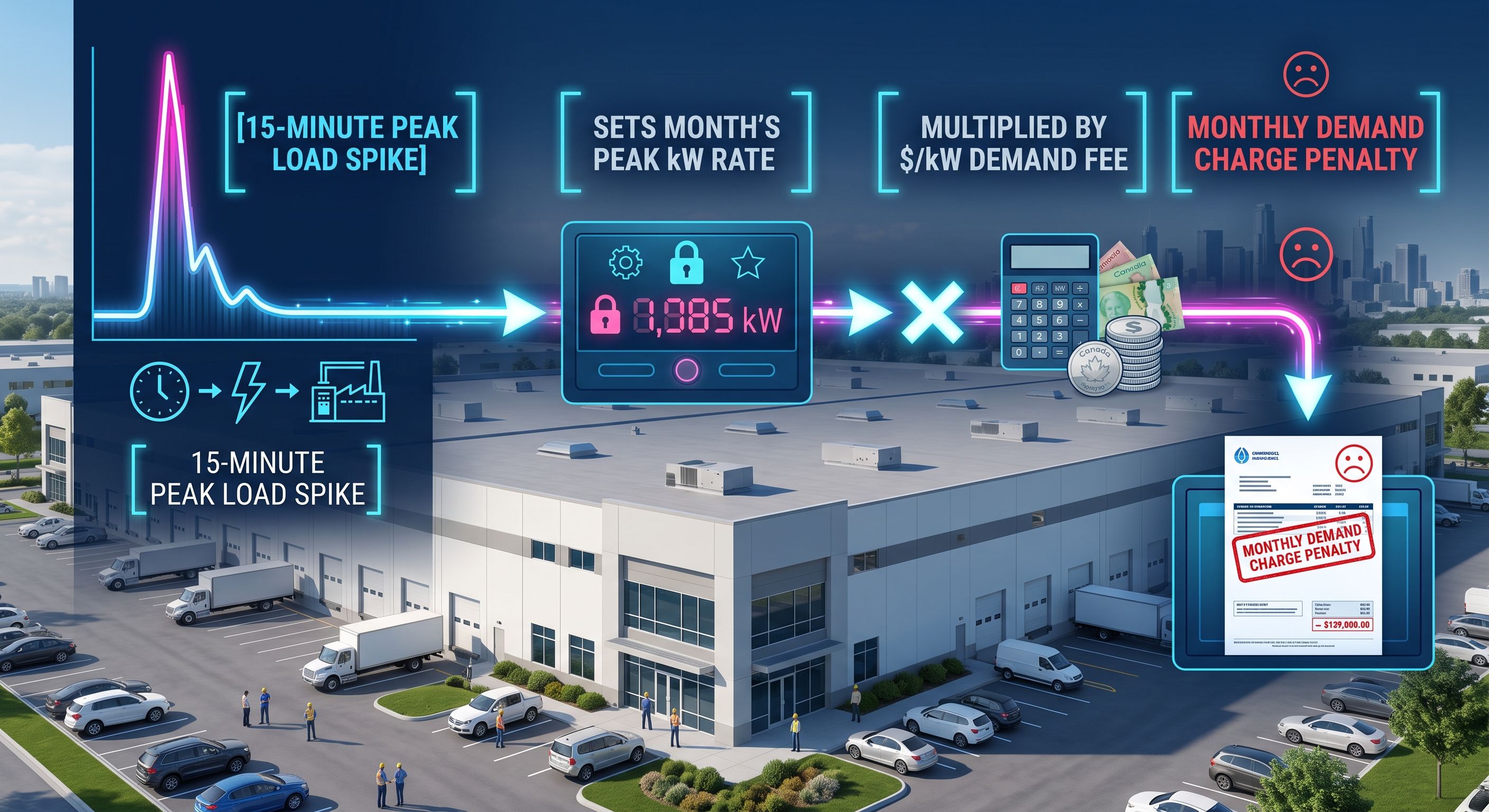
A demand charge is a fee applied by electric utilities based on the highest rate of electricity a commercial facility draws from the grid during a short, specific window—typically a 15-minute interval—within a billing cycle.
While your energy usage fee covers the total amount of power consumed over time, the demand charge covers the maximum rate at which your property required that power.
How Solar + BESS Eliminates Peak Demand Spikes
- Why Solar Alone Isn't Enough: Standalone solar PV systems generate power during daylight hours, reducing overall energy usage (kWh). However, if cloud cover occurs during an operational spike, or if a facility’s peak load happens at 6:00 PM, a standalone solar array cannot prevent grid demand spikes.
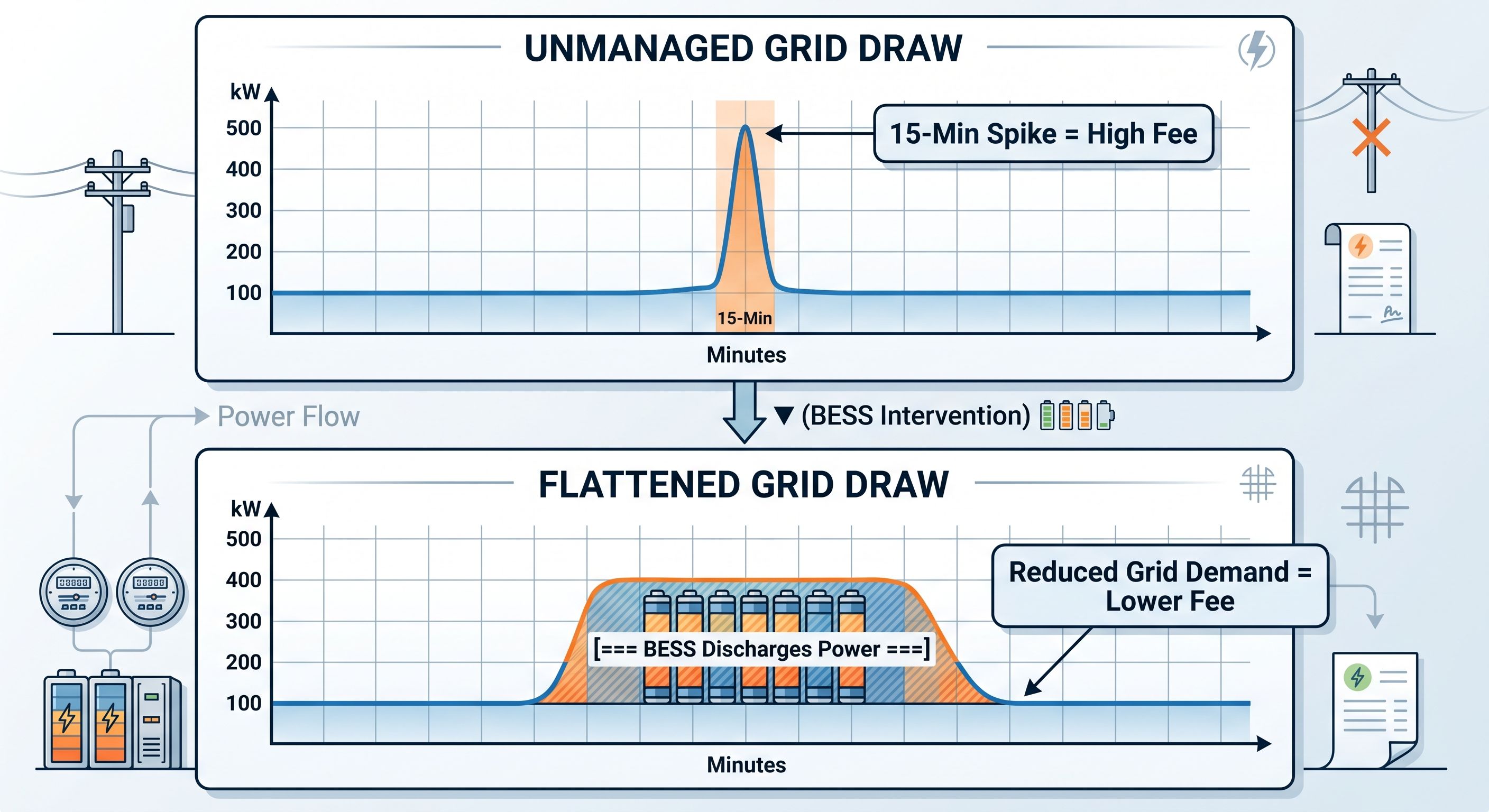
- Dynamic BESS Intervention: A smart BESS continually monitors facility power draw in real time. The moment grid demand approaches a pre-programmed threshold, the battery instantly discharges stored energy to cover the excess load. From the utility meter's perspective, the peak never happened.
- Energy Arbitrage: Advanced battery storage systems can charge from your solar array during peak daytime production ($0/kWh) or from the grid overnight during low-rate windows, then discharge during high-cost time-of-use (TOU) hours.
- Uninterrupted Backup Power: Beyond load management, a commercial BESS provides reliable backup power during unexpected grid blackouts, protecting sensitive machinery, data hubs, and refrigeration assets.
Take Control of Your Commercial Energy Costs
Demand charges do not have to remain an unpredictable operational tax on your business. By deploying intelligent peak shaving strategies powered by commercial solar and battery storage, you can cap your peak demand, stabilize monthly utility expenses, and capture available clean energy tax incentives.
Ready to eliminate demand charge penalties? Contact our commercial energy specialists today to analyze your utility interval data, identify hidden demand spikes, and engineer a custom Solar + BESS solution for your property.
Frequently Asked Questions (FAQs)
1. What is the difference between peak kW and energy usage kWh?
Kilowatt (kW) measures demand—the instantaneous rate at which your facility uses power at any single moment. Kilowatt-hour (kWh) measures energy usage—the cumulative volume of power consumed over a period of time.
2. How long is a standard demand charge measurement interval?
Most commercial utility meters track demand in 15-minute intervals (though some utilities use 5-minute or 30-minute windows). The highest average kilowatt draw recorded during any single interval in the billing period determines your monthly demand charge.
3. Do small businesses pay demand charges?
It depends on the utility rate class. While demand charges primarily target medium-to-large commercial and industrial facilities, many utilities apply demand charges to small businesses if their power draw exceeds a specific threshold (e.g., 10 kW or 20 kW).
4. Can solar panels alone eliminate my demand charges?
Rarely. While solar panels reduce total electricity consumption (kWh), they cannot guarantee demand charge reductions because solar output varies with weather and time of day. Pairing solar with a Battery Energy Storage System (BESS) ensures reliable, controlled peak shaving regardless of weather conditions.
5. How much can a Battery Energy Storage System (BESS) lower demand charges?
Depending on a facility's load profile, utility tariff structure, and system sizing, an automated BESS can reduce monthly demand charges by 20% to over 70%, delivering rapid return on investment (ROI) for commercial enterprises.
The Speedometer vs. Odometer Metaphor
To visualize the difference between peak demand and energy usage, consider driving a car:
- Energy Consumption (kWh) = The Odometer: This measures the total distance driven. If you drive 100 miles, your odometer records 100 miles, regardless of whether you drove slowly or fast.
- Peak Demand (kW) = The Speedometer: This measures how fast you were driving at your top speed. Reaching 100 mph for even 15 minutes requires a far more powerful engine and stronger road infrastructure than driving 25 mph for four hours—even though both cover the exact same distance.
Why Do Utilities Levy Demand Charges?
Electric utilities must maintain infrastructure—including power plants, transformers, transmission lines, and substations—capable of delivering maximum required power at any given instant.
If a manufacturing plant, data center, or EV charging station suddenly draws a massive surge of electricity for just 15 minutes, the utility grid must have adequate standby capacity to supply that burst safely. Demand charges ensure that high-demand commercial customers contribute fairly to maintaining this heavy-duty grid infrastructure.
How Demand Charges Are Calculated
Calculating a commercial electricity demand charge follows a basic formula, though billing mechanisms can vary by regional utility tariffs:
$Monthly Demand Charge = Peak Demand (kW) x Demand Rate ($/kW)
Calculation Example:
Suppose a commercial warehouse has a peak 15-minute load spike of 500 kW during the month. If the utility’s demand rate is $15 per kW, the demand charge calculation is:
500/kW x $15/kW = $7,500
Even if that 500 kW spike lasted for only 15 minutes out of a 720-hour month, the facility is billed $7,500 for that single operational peak.
Watch Out for the "Ratchet Demand Charge"
Some utilities employ a ratchet clause. Under a ratchet demand design, if your facility sets an exceptionally high peak demand spike during a summer or winter month, the utility sets your billing baseline at a percentage (e.g., 80%) of that historical peak for the following 11 to 12 months—even during months when your actual demand is significantly lower.
How to Reduce Demand Charges
Managing peak load requires strategic operational adjustments and modern technology. Here are four primary peak shaving strategies used by commercial facilities:
1. Equipment Staggering and Operational Scheduling
Simultaneously starting high-capacity machinery—such as industrial air compressors, chillers, pumps, or heavy conveyors—at 8:00 AM creates an artificial demand spike. Staggering startup sequences over 30 to 60 minutes flattens the demand curve.
2. Strategic Load Shedding
Identify non-critical operational loads that can be temporarily throttled or paused when total facility power draw nears a designated kilowatt threshold.
3. Smart HVAC and Building Automation
Integrate smart Energy Management Systems (EMS) that regulate HVAC compressors and lighting levels automatically to prevent peak draw overlaps.
4. Peak Shaving with BESS
Peak shaving involves introducing an alternative on-site energy source to supply power specifically during periods of high demand, effectively "shaving off" the top of the grid draw curve.
The Ultimate Solution: Solar + Battery Energy Storage Systems (BESS)
While operational staggering helps, human error and unpredictable production schedules can still lead to costly load spikes. Combining commercial solar arrays with a Battery Energy Storage System (BESS) provides automated, continuous protection against demand penalties.
How Solar + BESS Eliminates Peak Demand Spikes
- Why Solar Alone Isn't Enough: Standalone solar PV systems generate power during daylight hours, reducing overall energy usage (kWh). However, if cloud cover occurs during an operational spike, or if a facility’s peak load happens at 6:00 PM, a standalone solar array cannot prevent grid demand spikes.
- Dynamic BESS Intervention: A smart BESS continually monitors facility power draw in real time. The moment grid demand approaches a pre-programmed threshold, the battery instantly discharges stored energy to cover the excess load. From the utility meter's perspective, the peak never happened.
- Energy Arbitrage: Advanced battery storage systems can charge from your solar array during peak daytime production ($0/kWh) or from the grid overnight during low-rate windows, then discharge during high-cost time-of-use (TOU) hours.
- Uninterrupted Backup Power: Beyond load management, a commercial BESS provides reliable backup power during unexpected grid blackouts, protecting sensitive machinery, data hubs, and refrigeration assets.
Take Control of Your Commercial Energy Costs
Demand charges do not have to remain an unpredictable operational tax on your business. By deploying intelligent peak shaving strategies powered by commercial solar and battery storage, you can cap your peak demand, stabilize monthly utility expenses, and capture available clean energy tax incentives.
Ready to eliminate demand charge penalties? Contact our commercial energy specialists today to analyze your utility interval data, identify hidden demand spikes, and engineer a custom Solar + BESS solution for your property.
People Also Ask
1. What is the difference between peak kW and energy usage kWh?
Kilowatt (kW) measures demand—the instantaneous rate at which your facility uses power at any single moment. Kilowatt-hour (kWh) measures energy usage—the cumulative volume of power consumed over a period of time.
2. How long is a standard demand charge measurement interval?
Most commercial utility meters track demand in 15-minute intervals (though some utilities use 5-minute or 30-minute windows). The highest average kilowatt draw recorded during any single interval in the billing period determines your monthly demand charge.
3. Do small businesses pay demand charges?
It depends on the utility rate class. While demand charges primarily target medium-to-large commercial and industrial facilities, many utilities apply demand charges to small businesses if their power draw exceeds a specific threshold (e.g., 10 kW or 20 kW).
4. Can solar panels alone eliminate my demand charges?
Rarely. While solar panels reduce total electricity consumption (kWh), they cannot guarantee demand charge reductions because solar output varies with weather and time of day. Pairing solar with a Battery Energy Storage System (BESS) ensures reliable, controlled peak shaving regardless of weather conditions.
5. How much can a Battery Energy Storage System (BESS) lower demand charges?
Depending on a facility's load profile, utility tariff structure, and system sizing, an automated BESS can reduce monthly demand charges by 20% to over 70%, delivering rapid return on investment (ROI) for commercial enterprises.