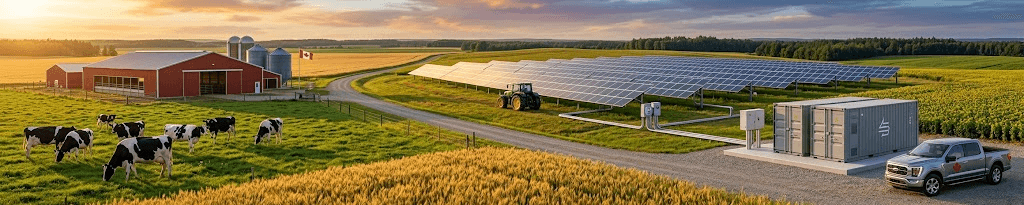
Powering the Field: How Solar and Battery Storage are Revolutionizing Canadian Agriculture
Canadian farmers are the backbone of the nation’s food security, managing vast landscapes while navigating unpredictable weather, complex global markets, and razor-thin profit margins. To remain competitive and sustainable, modern operations must evolve, adopting advanced technologies that improve yield and lower overhead.
While tractors and irrigation systems are vital, the most significant shift on the modern farm is happening within its electrical infrastructure. Integrating solar and battery storage for agriculture is no longer a fringe environmental statement; it is a critical, professional financial strategy that delivers long-term resilience and operational certainty to the agricultural sector.
The Financial Storm Facing Canadian Farms
Modern farming operations are incredibly energy-intensive. Whether running sophisticated greenhouse climate controls, massive grain drying systems, or sophisticated dairy automation, the demand for reliable power is constant.
However, two significant financial challenges are threatening the profitability of Canadian agriculture:
1. Skyrocketing Electricity Rates
The base rate for electricity across nearly all Canadian jurisdictions is on a consistent upward trajectory. Utilities are investing billions to modernize aging transmission and distribution infrastructure, and these capital costs are being passed directly to the consumer. For a farm with high baseline consumption, these annual rate hikes accumulate quickly, eroding profitability.
2. PUNISHING High Demand Charges
For many commercial and industrial agricultural operations, the volume of energy consumed (kWh) is only part of the problem. Utilities levy a demand charge based on the single highest amount of power your facility draws from the grid during any short window (typically 15 minutes) throughout the entire billing cycle.
A single heavy piece of machinery, such as an irrigation pump or grain dryer, kicking in simultaneously can set an exponentially high demand tariff for the entire month, even if that equipment ran for only a fraction of the billing cycle. Demand charges often account for 30% to over 50% of a large farm's entire electricity bill.
The Solution: Why Solar and Battery Help
Integrating an intelligent on-site renewable energy system directly addresses these financial vulnerabilities, transforming energy from a variable liability into a controlled asset.
1. Harnessing $0/kWh Solar Production
A commercial-grade solar array converts abundant sunlight into clean, usable electricity for your operation. By generating your own power on rooftops, in marginal fields, or even over crops (known as agrivoltaics), you immediately reduce your reliance on the public grid. Every kilowatt-hour your panels produce is energy you do not have to purchase at a volatile, rising utility rate.
2. Unlocking Peak Shaving with Battery Storage (BESS)
The game-changer for modern energy efficiency on farms is the solar and battery for agriculture combination. While solar reduces overall consumption, it cannot guarantee the elimination of costly demand spikes because production depends on the weather and the sun's position.
A specialized on-site Battery Energy Storage System (BESS) provides automated protection against high demand charges through a mechanism called peak shaving.
How it Works: The smart BESS continually monitors your farm's total grid draw in real time. The moment grid draw approaches a predetermined, high-cost threshold (the peak window), the battery instantly and seamlessly discharges its stored energy to cover the excess load. From the utility meter’s perspective, the high demand spike was shaved off, leading to substantial structural reductions in your monthly power bill.
3. Load Shifting and Energy Arbitrage
By stacking these technologies, farmers can perform load shifting (moving high-energy operations to hours when solar is abundant) and energy arbitrage (charging batteries when grid rates are at their absolute lowest—often overnight—and discharging them during expensive mid- or on-peak time-of-use windows).
Capitalizing on Financial Incentives: A Provincial Breakdown
To encourage agricultural modernization and sustainable farming technology, Canadian municipal, provincial, and federal governments offer deeply aggressive rebates and tax provisions. Stacking these instruments drastically improves ROI, making the business case for agricultural solar undeniable.
Factual Overview of Active Farm Energy Efficiency Rebates:
| Province / Region | Specific Incentive Program | Target / Farm Eligibility | Financial Impact (Summary) |
|---|---|---|---|
| Ontario | Save on Energy Retrofit Program | Rooftop standalone solar (10 kW – 1 MW). Agricultural BTM load displacement via BESS is eligible (non-exporting). | • Pre-June 30, 2026: $860 per kW AC. • Post-June 30, 2026: Incentive drops 10% to $770 per kW AC. |
| Alberta | Clean Energy Improvement Program (CEIP) & Emissions Reduction Alberta Capital Retrofits | Flexible financing repaid through the property tax bill. Agricultural operations are generally eligible within participating municipalities (e.g., Sturgeon County). | Up to 100% project cost financing at low, competitive rates, allowing farms to become cash-flow positive from Year 1 while maintaining standard micro-generation status. |
| British Columbia | BC Hydro Business Solar Rebate | Solar PV and standalone BESS (5 kWh min). Agri-businesses served by BC Hydro are eligible (load displacement). | Stacking: up to 50% of installed costs; capped at $10,000 for solar and $10,000 for BESS (Total potential: $20,000). Note: Expanded caps exist for Indigenous governing bodies. |
| Nova Scotia | Nova Scotia Power Commercial Net Metering | Net metering for systems up to 1 MWac. Must be sized for self-generation up to 100% of annual load. | Firms must be a farm registered under the Farm Registration Act to qualify for commercial net-metering status, enabling them to bank surplus solar and maximize system value. |
Powerful Federal Provisions (Canada-Wide)
Stackable with provincial programs, commercial agricultural operations have access to deeply aggressive federal tax instruments:
- Federal 30% Clean Technology Investment Tax Credit (ITC): Canadian corporations, including agricultural businesses, qualify for a 30% refundable tax credit on the total capital equipment costs of the solar and BESS asset. CRA will issue a direct refund check if your entity owes no corporate tax that fiscal year.
- Accelerated Capital Cost Allowance (CCA): Under Class 43.1 / 43.2, commercial farms can claim a depreciation write-off in the very first year of operation, drastically lowering immediate corporate income tax liabilities.
Take the Next Step Toward Energy Independence
Integrating solar and battery storage for agriculture is not merely a hedge against inflation; it is a foundational upgrade that secures predictable power, eliminates demand penalties, and strengthens the operational resiliency of the modern farm. In an increasingly unstable energy environment, taking control of your production is the smartest investment a Canadian enterprise can make.
Ready to future-proof your energy portfolio and capture active provincial incentives before upcoming seasonal deadlines pass? Contact our specialized agricultural engineering team today for a comprehensive virtual site assessment, custom ROI projection, and complete help fast-tracking your application process while funding remains active.
People Also Ask
1. Can we net-meter a ground-mount solar array on our farm?
In many provinces, ground-mounted systems are eligible under commercial net-metering regulations, provided they are accurately sized to meet, but not exceed, the farm's historical annual electrical load (kW). However, specific rebate streams, such as Ontario’s Retrofit Program, may strictly require a non-exporting rooftop-mounted design to capture the direct cash grant. Top turnkey providers will guide you to ensure compliance with localized micro-generation rules.
2. Can we install agrivoltaics (dual-use farming)?
Absolutely. A solar and battery for agriculture assessment will determine the best layout to combine high-performance generation with active crop or livestock production. Elevated ground-mount systems with specific panel spacing are ideal for sheep grazing, certain vegetable production (agrivoltaics studies show benefits for crops like sweet corn), and protecting livestock from extreme weather.
3. How do property taxes affect the ROI on farm solar?
This varies significantly by province. In some areas, such as New Brunswick and Prince Edward Island, adding a solar system will not trigger an increase in your annual property tax assessment. However, in Alberta, property owners should consult municipal CEIP guidelines to confirm if their solar equipment property tax exemption is secure. PACE property-linked financing is also available in some regions.
4. What is the typical maintenance required for a BESS container on a farm?
Very minimal. BESS containers are self-contained generating assets. Minimal routine checkups and ensuring clean ventilation are typically required, with most components streamlined and managed digitally. Solar panels themselves have no moving parts, require almost zero maintenance beyond seasonal cleaning (or snow clearing, if active year-round), and are streamlined to last over 30 years. Leading monocrystalline panels maintain approximately 85% of their original output.