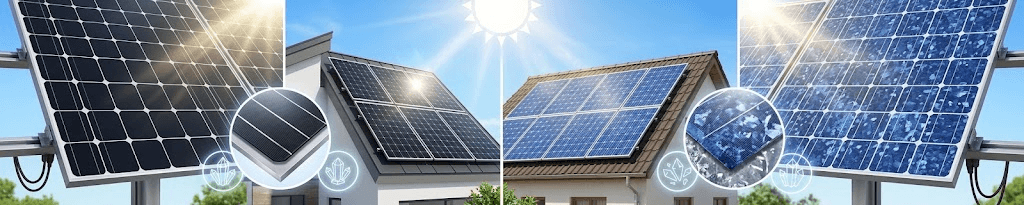
Polycrystalline vs Monocrystalline Solar Panels
Choosing the right photovoltaic technology is a foundational decision that impacts your system's lifetime energy yield, rooftop footprint, and financial return. While both monocrystalline and polycrystalline solar panels convert sunlight into usable electricity, key structural differences in their silicon cell architecture dictate how effectively they perform. Understanding these differences ensures you select the optimal panel type for your property's energy demands.
Key Differences Between Polycrystalline and Monocrystalline
The core distinction between these two technologies lies in the purity and structure of their silicon cells.
- Monocrystalline Solar Panels: Manufactured from a single, continuous silicon crystal ingot sliced into thin wafers. Because the cell is composed of pure single-crystal silicon, electrons flow freely, delivering high efficiency rates between 20% and 23%+. They are recognizable by their uniform, sleek black solar panel appearance.
- Polycrystalline Solar Panels: Made by melting multiple silicon fragments together into square molds. The resulting cell contains many individual crystals, creating grain boundaries that restrict electron movement. This limits efficiency to between 15% and 17% and gives the panels a blue, speckled aesthetic.
| Feature | Monocrystalline Panels | Polycrystalline Panels |
|---|---|---|
| Efficiency Rating | High (20% – 23%+) | Moderate (15% – 17%) |
| Appearance | Uniform Black | Speckled Blue |
| Space Efficiency | High (More watts per sq. ft.) | Lower (Requires more roof area) |
| Temperature Coefficient | Superior (Loses less output in heat) | Higher loss in high heat |
| Average Lifespan | 25 – 30+ Years | 25 Years |
Impact on Commercial Demand Charges
For commercial and industrial properties, panel efficiency plays a direct role in financial management. Utilities levy a demand charge based on a facility's single highest 15-minute peak power draw during a billing period. Because monocrystalline panels generate significantly more power per square foot, they maximize on-site energy generation on constrained rooftops. This higher power density is essential for effective commercial solar demand charge reduction, helping businesses shave costly afternoon peak load spikes when grid power is most expensive.
The Market Trend: Why Monocrystalline Now Dominates
Polycrystalline panels once commanded a significant market share due to their lower manufacturing costs. However, the global solar market has shifted almost entirely toward monocrystalline technology.
- Closing Price Gap: Advanced manufacturing techniques have drastically reduced the production cost of single-crystal silicon wafers, making monocrystalline panels affordable for virtually all project budgets.
- Next-Gen Cell Technology: Innovations like TOPCon (Tunnel Oxide Passivated Contact) and N-type cells are built exclusively on monocrystalline silicon, pushing panel conversion efficiencies beyond 23%.
- Superior Thermal Performance: Monocrystalline options feature a lower solar panel temperature coefficient, meaning they maintain higher power output during hot summer days when electricity demand and utility rates peak.
Optimize Your Energy Strategy
Selecting high-efficiency monocrystalline solar panels ensures maximum energy production, long-term durability, and superior protection against rising utility rates and peak demand surcharges.
Ready to design your clean energy system? Contact our engineering team today for a custom site analysis, production modeling, and ROI forecast tailored to your property.
People Also Ask
1. What is the main difference between monocrystalline vs polycrystalline solar panels?
Monocrystalline panels are made from a single silicon crystal, resulting in higher efficiency (20%–23%+) and a sleek black appearance. Polycrystalline panels are made from multiple silicon fragments fused, resulting in lower efficiency (15%–17%) and a blue-speckled appearance.
2. How does solar panel efficiency help lower a commercial demand charge?
Your facility's peak kilowatt draw from the grid sets a demand charge. Higher-efficiency monocrystalline panels produce more electricity in limited space, supplying a larger volume of instantaneous solar power to offset heavy operational equipment and shave peak demand spikes from your utility bill.
3. Are polycrystalline solar panels still widely used?
Polycrystalline panels have largely been phased out of mainstream residential and commercial installations. Modern tier-1 manufacturers almost exclusively produce monocrystalline panels due to their superior efficiency, longer warranties, and declining production costs.
4. How does the solar panel temperature coefficient affect summer performance?
The solar panel temperature coefficient measures how much power output drops for every degree the panel exceeds 25°C (77°F). Monocrystalline panels have a lower (better) temperature coefficient than polycrystalline panels, allowing them to perform more efficiently during hot summer afternoons.