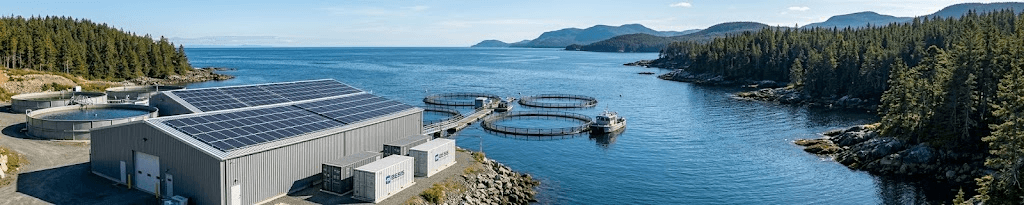
Safeguarding the Harvest: How Solar and Battery Systems Transform Canadian Aquaculture
Canada’s aquaculture and seafood processing sector is a vital economic engine, generating billions in economic output across coastal and inland waters. From land-based Recirculating Aquaculture Systems (RAS) and salmon hatcheries to shellfish farming and processing plants, operating a successful facility demands uncompromising precision.
However, modern fish farming is exceptionally energy-intensive. Maintaining optimal water quality, oxygenation, thermal control, and biosecurity requires heavy equipment running around the clock. Integrating solar and battery storage for aquaculture operations has evolved from a progressive environmental goal into an indispensable risk-management and financial strategy.
The Financial and Operational Threats Facing Aquaculture
Operating a commercial aquaculture site presents unique electrical demands that expose operators to mounting financial and biological risks:
- Relentless Utility Rate Increases: Energy tariffs across coastal provinces are escalating annually. Because recirculating pumps, biofilters, water chillers, and oxygen injectors must operate 24/7/365, rising baseline electricity rates directly squeeze operating margins.
- Punishing Commercial Demand Charges: Utilities charge commercial operations a demand charge based on the highest 15-minute load spike recorded during a billing period. When heavy-duty chillers or automated feeding blowers start simultaneously, they create severe demand spikes that can account for 30% to over 50% of the monthly power bill.
- Vulnerability to Grid Outages: For livestock facilities, a power interruption is a catastrophic biological emergency. If main power drops and backup generators fail to ignite instantly, dissolved oxygen levels in high-density tanks drop rapidly, risking millions of dollars in live fish or shellfish stock within minutes.
Why Solar and Battery Systems Are the Ultimate Solution
Combining high-efficiency photovoltaic panels with a commercial-grade Battery Energy Storage System (BESS) directly resolves these challenges.
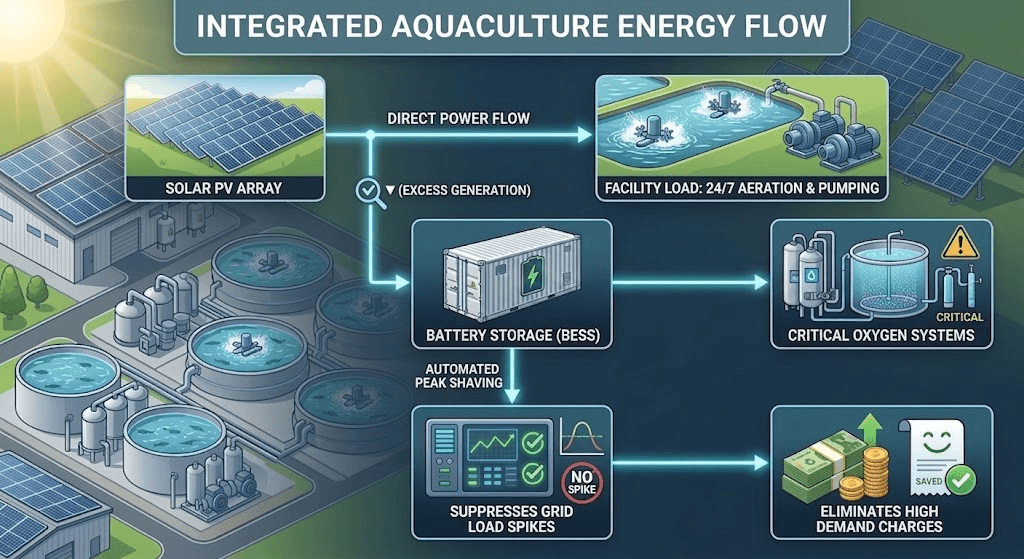
1. Offsetting 24/7 Baseline Energy Loads
Aquaculture solar energy systems generate low-cost power directly on facility rooftops, processing plants, or nearby land. Every kilowatt-hour generated on-site offsets grid power, insulating operations from volatile utility rate hikes.
2. Automated Peak Shaving for Fish Farms
A battery storage system continually monitors your facility's real-time power draw. When large pumps or refrigeration compressors cycle on, the BESS instantly discharges stored solar power to absorb the shock. From the utility meter’s perspective, the peak never happened, delivering substantial peak shaving for fish farms and dramatically reducing monthly demand fees.
3. Uninterrupted Life-Support Protection
Beyond financial returns, a BESS acts as an instantaneous, clean uninterruptible power supply (UPS). If severe coastal weather causes a utility blackout, the battery system bridges the critical gap immediately, powering aerators, oxygen injection systems, and monitoring sensors without missing a single cycle.
Provincial Rebates and Tax Credits: BC, Nova Scotia, and PEI
Canadian federal and provincial governments offer lucrative incentives designed to accelerate clean tech adoption across seafood and agricultural supply chains.
| Province | Incentive Program | Target & Eligibility | Financial Impact & Value |
|---|---|---|---|
| British Columbia | BC Hydro Business Solar & Battery Rebates | Commercial electricity customers, marine hatcheries & seafood processing plants | • Solar PV: Up to $10,000 ($1,000/kW) • BESS Storage: Up to $10,000 ($500/kWh) • Export Credit: 10¢/kWh via BC Hydro Self-Generation rate |
| Nova Scotia | Fisheries & Aquaculture Energy Efficiency Innovation Fund (FAEEIF) | Licensed aquaculture operations, fish farms, hatcheries & seafood processors | • Renewables Pathway: 50% cost coverage up to $100,000 • Electrification Pathway: Cost coverage up to $350,000 • Access to Commercial Net Metering |
| Prince Edward Island | PEI Seafood & Agricultural Energy Grants *Application closed on Feb 9th, 2026 | Island hatcheries, aquaculture growers & commercial seafood processing facilities | • Provincial clean energy funding grants to offset capital equipment and installation costs |
Nationwide Federal Tax Incentives (Applicable in All Provinces)
Commercial aquaculture operations across all Canadian provinces can stack localized provincial rebates with major federal tax mechanisms. The Federal Clean Technology Investment Tax Credit (ITC) offers a 30% refundable tax credit on total capital hardware and installation costs for clean energy assets like solar arrays and battery storage (BESS). In addition, under Classes 43.1 and 43.2 of the Accelerated Capital Cost Allowance (CCA), taxable commercial businesses can leverage a depreciation write-off for qualified clean generation equipment, drastically lowering immediate corporate income tax liabilities anywhere in Canada.
Secure Your Facility's Energy Future
Deploying solar and battery storage for aquaculture yields three major advantages: it controls operating costs, slashes demand penalties, and safeguards livestock against grid instability. Stacking provincial grants like Nova Scotia's FAEEIF or BC Hydro's business rebates with the 30% federal tax credit dramatically accelerates project payback.
Ready to protect your facility and cut utility overhead? Contact our marine and agricultural energy engineering team today for a custom site evaluation, load profile analysis, and step-by-step assistance in securing active provincial grant funding.
People Also Ask
1. Can solar panels withstand coastal marine environments?
Yes. Commercial aquaculture solar energy systems deployed near saltwater or offshore facilities utilize weather-hardened, marine-grade anodized aluminum racking and anti-corrosive glass coatings specifically certified to resist intense salt-air environments and high coastal wind loads.
2. How does a BESS protect live fish stock better than a diesel generator alone?
While diesel generators require several seconds to several minutes to start up and stabilize, a BESS provides instant, millisecond transfer. This seamless transition prevents delicate oxygen control systems, variable frequency drives (VFDs), and biological monitoring computers from rebooting or shutting down during minor voltage sags or major blackouts.
3. How do aquaculture solar rebates in Canada apply to seafood processing plants?
Seafood processing facilities qualify as commercial or industrial entities. In Nova Scotia, processing plants apply under the FAEEIF program. In BC, processing facilities qualify for BC Hydro business rebates, while all taxable Canadian corporations qualify for the federal 30% Clean Technology Investment Tax Credit.
4. Are ground-mounted solar arrays allowed on aquaculture land?
Yes. If roof space is limited or obstructed on hatcheries or processing plants, ground-mounted or racking systems can be installed on surrounding marginal land or near water intake structures, provided local municipal zoning and grid interconnection guidelines are met.