AI Data Centers and the Grid: How Soaring Power Demand Drives Up Rates and Endangers Canada's Emission Target
The rapid expansion of artificial intelligence is altering how we process information, manage businesses, and automate daily tasks. However, behind every seamless AI prompt and generative algorithm lies a vast physical network of hyper-scale data centers operating around the clock.
As technology companies race to build massive server facilities across North America, energy analysts and environmental advocates are raising alarm bells. A landmark study from Earthjustice highlights that the sheer scale of energy required by AI data centers is straining electricity grids, driving up wholesale fuel costs, and shifting expensive infrastructure expenditures onto ordinary ratepayers. In Canada—where grids are already balancing peak heating loads with electrification mandates—this sudden surge in electricity demand creates a direct conflict with the nation's overarching emissions target.
Why AI Data Centers Require Unprecedented Energy
Unlike traditional data storage facilities that primarily host static websites or file backups, AI-focused data centers house dense clusters of specialized Graphics Processing Units (GPUs) designed for continuous parallel processing.
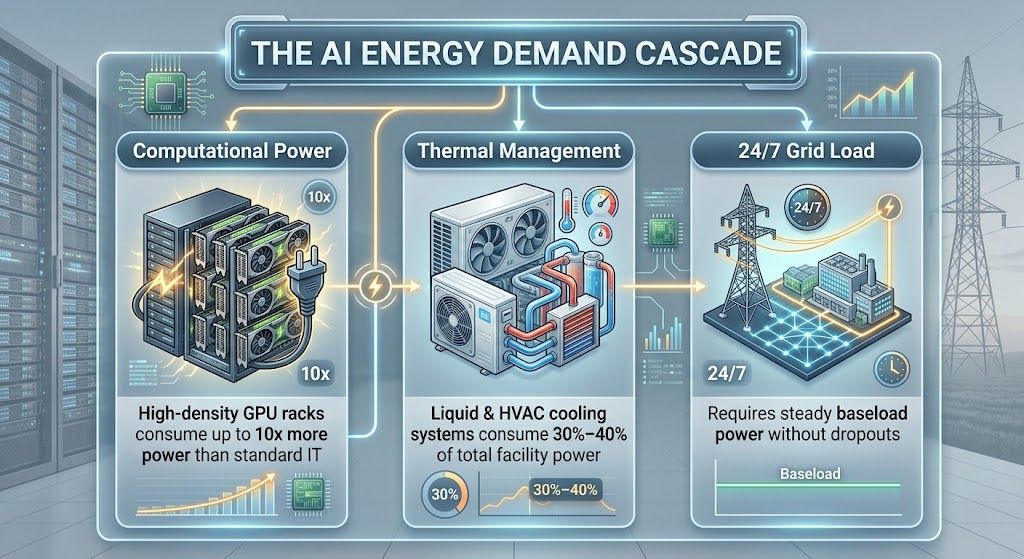
- High-Density Computation: Training a single large language model (LLM) or executing complex reasoning tasks can consume tens of megawatt-hours in a single session. An agentic query requiring multi-step reasoning can draw up to 50 times more electricity than a basic text search.
- Intense Cooling Needs: Standard air cooling is insufficient for high-temperature GPU racks. Modern facilities rely on industrial-scale chillers and liquid cooling loops, which account for roughly 30% to 40% of the building's total energy footprint.
- Uncompromising Baseload Requirements: AI workloads cannot tolerate power interruptions. Data centers demand 99.999% uptime, forcing utilities to supply high-capacity, non-intermittent power 24 hours a day, 365 days a year.
How AI Power Demand Affects Canadian Electricity Rates and Climate Goals
The arrival of hyper-scale data centers creates immediate friction across provincial electricity markets. While tech developers argue that data centers bring technological investment, the structural grid costs tell a different story for average utility customers.
1. Wholesale Fuel Spikes and Cost Shifting
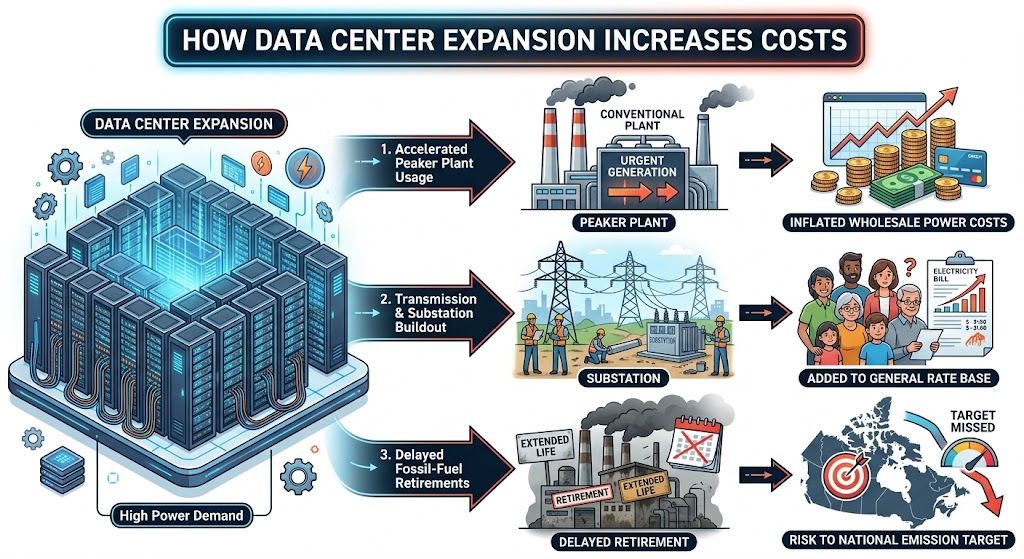
According to the Earthjustice analysis, when a multi-hundred-megawatt facility connects to the local grid, it dramatically increases the regional demand for natural gas during peak hours. This demand surge inflates the clearing price of electricity across the entire market. Furthermore, when utilities build out transmission lines, substations, and peaking plants to accommodate a proposed data center, those multi-million-dollar capital investments are frequently absorbed into the general rate base. If a data center delays its rollout or scales back operations, residential and small business customers are left footing the bill for the stranded grid infrastructure.
2. Grid Bottlenecks in Canada
Canada's electrical grid is facing a localized capacity challenge. In regions with concentrated tech development, the existing transmission infrastructure struggles to absorb massive, localized industrial loads. To prevent localized blackouts, utilities are forced to procure emergency peaking capacity, which is almost always the most expensive and carbon-intensive power available on the market.
3. Threats to the National Emission Target
The most significant long-term consequence of the AI boom is its impact on Canada's climate commitment. To meet its binding 2030 and 2050 emission target goals, Canada must phase out fossil-fueled electricity and rapidly expand clean energy generation. However, because renewable energy projects and battery storage buildouts require time to permit and construct, some utilities are opting to extend the operational lifespan of gas-fired power plants—or even deploy unpermitted diesel generators—to satisfy incoming data center contracts.
Burning fossil fuels to power digital processing directly undermines provincial clean-energy mandates, pushing the national emission target further out of reach.
The Clean Energy Trifecta: Why Solar, Batteries, and Heat Pumps Matter
To counter the compounding grid pressure from hyper-scale data centers, energy users must shift from passive grid consumption to active, localized energy management. Combining on-site solar PV, Battery Energy Storage Systems (BESS), and cold-climate heat pumps provides the most effective defense against soaring electricity costs while helping protect Canada's emissions target.
1. On-Site Solar PV: Displacing Daytime Peak Demand
Rooftop and commercial ground-mounted solar arrays generate clean electricity directly where it is consumed. By powering facility loads during peak daytime hours, solar PV reduces the net draw on the public grid. This prevents utilities from firing up expensive, polluting natural gas peaker plants to satisfy concurrent AI workloads and community needs.
2. Battery Storage (BESS): Shaving Peaks and Stabilizing the Grid
While solar handles daytime generation, a Battery Energy Storage System (BESS) acts as a strategic buffer. Battery systems store surplus clean energy and discharge it during high-cost evening windows—a practice known as peak shaving. This eliminates costly utility demand penalties for commercial operators and ensures clean power is available without relying on fossil-fueled baseload plants.
3. Cold-Climate Heat Pumps: Radical Thermal Efficiency
Heating and cooling account for the majority of a building's energy footprint. Modern cold-climate heat pumps operate at efficiencies of 200% to 400%, delivering up to four units of thermal energy for every unit of electricity consumed. Swapping out inefficient electric resistance or fossil-fuel heating for heat pumps drastically slashes overall baseline power consumption—freeing up critical grid capacity and ensuring broader electrification efforts do not overburden the grid.
Taking Control of Your Energy Future
As macro-grid pressures and industrial data demands push utility rates higher, waiting for top-down regulatory relief is no longer a viable strategy for property owners or commercial operators. Protecting your financial bottom line requires building localized energy independence.
By deploying on-site commercial solar PV, cold-climate heat pumps, and Battery Energy Storage Systems (BESS), businesses and homeowners can bypass peak utility pricing, insulate themselves from cost-shifting tariffs, and directly reduce the carbon intensity of the local grid.
Ready to shield your property from volatile utility rates? Contact our clean energy engineering team today for a custom evaluation on how solar, energy storage, and smart efficiency retrofits can protect your bottom line while advancing Canada's net-zero transition.
People Also Ask
1. How do AI data centers increase residential electricity rates?
When large data centers connect to the grid, utilities must build new transmission lines, substations, and power plants to meet the high demand. If regulators do not force data center developers to pay 100% of these infrastructure costs upfront, utilities distribute the expenses across all ratepaying customers, driving up monthly electricity bills.
2. Will energy consumption from AI cause Canada to miss its emission target?
It creates a significant risk. If utilities fulfill rapid data center growth by extending the life of natural gas plants or adding fossil-fuel generators instead of clean renewables, overall greenhouse gas emissions will rise, making it much harder for Canada to hit its 2030 and 2050 emission target.
3. How much electricity does an AI data center consume compared to a typical home?
A large AI data center (ranging from 100 MW to 500 MW) can consume as much electricity as 80,000 to 400,000 homes combined. Because data centers run continuously at high capacity, their annual energy consumption far exceeds almost any other commercial or residential facility.
4. Can AI data centers run entirely on clean, renewable energy?
Yes, but it requires strategic planning. Tech companies can pair solar and wind farms with high-capacity Battery Energy Storage Systems (BESS) or nuclear power agreements to ensure their 24/7 operations are supplied by zero-carbon electricity, preventing added strain on fossil-fueled power plants.