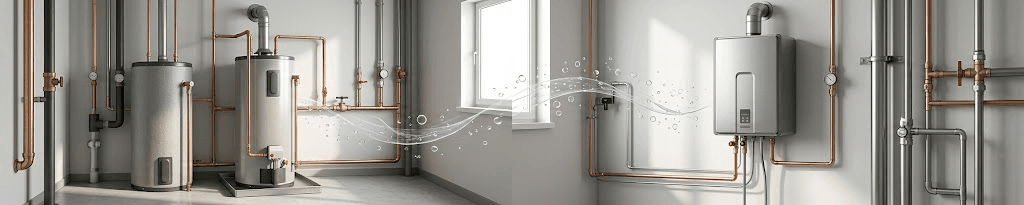
Tank vs Tankless Water Heater: Choosing the Right Hot Water System
Choosing a new water heater is one of the most critical mechanical decisions you can make for your home, directly impacting your monthly energy bills and daily living comfort. Deciding between a tank vs tankless water heater comes down to balancing upfront installation costs against long-term energy efficiency, available square footage, and your household's peak hot water demand.
How a Tank Water Heater Works
A conventional tank water heater maintains a stored reserve of 40 to 80 gallons of water heated to a set temperature around the clock.
- Cold water enters near the bottom of the insulated steel cylinder through a dip tube.
- Natural gas burners or electric heating elements warm the water continuously.
- Hot water rises to the top of the tank and is drawn through supply pipes whenever a hot tap opens in the house.
- Because the system constantly reheats stored water whether you are using it or not, it suffers from standby heat loss, which inflates overall utility bills.
How a Tankless Water Heater Works
An on-demand water heater operates without a storage tank, heating water exclusively when a fixture calls for it.
- When a hot water faucet opens, cold water flows directly into the compact wall-mounted unit.
- Internal flow sensors detect movement and trigger high-output gas burners or electric elements.
- The water passes through a high-efficiency heat exchanger, heating instantly before traveling to your tap.
- The heating mechanism shuts down immediately when the tap closes, eliminating standby heat loss and delivering an endless stream of hot water up to the unit's gallon-per-minute (GPM) threshold.
Tank vs Tankless Water Heater: Core Differences
| Feature | Tank Water Heater | Tankless Water Heater |
|---|---|---|
| Hot Water Supply | Capped by storage capacity (40–80 gal); requires recovery time to reheat once empty. | Continuous flow (endless); output capped by flow rate (GPM). |
| Energy Efficiency | Lower efficiency (40%–60%) due to continuous standby heat loss. | High efficiency (80%–99%) with zero standby energy waste. |
| Installed Upfront Cost | Lower initial cost | Higher initial investment |
| Average Lifespan | 8 to 15 years. | 15 to 30 years. |
| Space Required | Large floor footprint required in basement or mechanical room. | Compact wall-mounted design frees up valuable floor space. |
| Installation Complexity | Straightforward replacement into existing plumbing and venting. | Complex; often requires enlarged gas lines, dedicated circuits, or specialized venting. |
| Maintenance Needs | Annual sediment flushing and periodic sacrificial anode rod inspection. | Annual heat exchanger descaling/flushing to remove mineral scale. |
Which Property Type Is Ideal for Each System?
Ideal for Tank Water Heaters:
- Starter Homes & Budget-Conscious Builds: Perfect if minimizing initial out-of-pocket costs is your primary priority.
- Rental and Investment Properties: Ideal when ownership horizons are short or unpredictable.
- Homes with Legacy Infrastructure: Best for older structures where upgrading gas line sizes or electrical panels would be financially impractical.
Ideal for Tankless Water Heaters:
- Forever Homes & Long-Term Residences: Excellent for homeowners staying in their property for 10+ years who want maximum energy efficiency and long equipment lifespan.
- High-Demand Households: Great for large families where multiple showers and appliances frequently run back-to-back.
- Space-Constrained Properties & Condos: Ideal for smaller mechanical rooms or closets where wall mounting saves essential floor space.
- Vacation Homes: Outstanding for secondary residences because zero energy is wasted keeping water hot while the house sits vacant.
Upgrade Your Hot Water System Today
Investing in the right hot water system boosts your home's long-term energy efficiency, comfort, and resale value. Whether you prefer the lower initial outlay of a traditional storage tank or the space-saving, endless hot water delivery of a tankless system, professional sizing is essential for optimal performance.
Ready to find the perfect water heater for your home? Contact our licensed plumbing and heating professionals today to schedule a site evaluation and receive a customized quote.
People Also Ask
1. Can a tankless water heater run out of hot water?
No, a tankless water heater cannot run out of hot water in the traditional sense because it heats water on demand indefinitely. However, it is restricted by its maximum flow rate (GPM). Running multiple high-demand fixtures simultaneously—such as two showers and a dishwasher—can cause water temperatures to drop if the system is undersized.
2. Is a tankless water heater worth the higher upfront cost?
For long-term homeowners, yes. Because tankless units last up to 20 to 30 years—nearly double the lifespan of standard storage tanks—and lower energy usage by up to 34%, the accumulated utility savings and avoided replacement cycles offset the initial installation cost over time.
3. What special maintenance does a tankless water heater require?
Tankless systems require annual descaling (flushing the internal lines with a mild acid or vinegar solution) to remove mineral and lime scale buildup from the heat exchanger. This is crucial in hard-water areas to maintain high efficiency and keep manufacturer warranties valid.
4. Will a tankless water heater work during a power outage?
Most modern gas-fired tankless units rely on electricity to power electronic ignition systems, digital control boards, and flow sensors. Unless connected to a backup battery or emergency generator, a tankless unit will not operate during a blackout, whereas traditional gas tank heaters with standing pilot lights can continue to heat water without grid power.