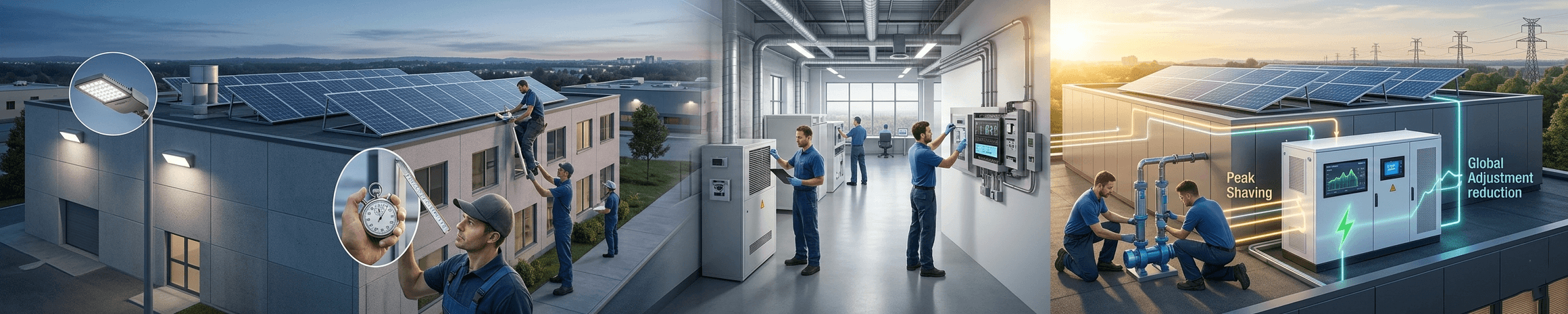
Commercial SaveOnEnergy Retrofit Update 2026: The Strategic Blueprint for Ontario Businesses
Managing a commercial, industrial, or institutional facility in Ontario means playing a continuous game of defense against volatile operational overhead. For nearly two decades, the province’s premier pathway to softening these financial blows has been the Independent Electricity System Operator's (IESO) flagship conservation framework. However, corporate energy planning cannot remain static when utility rules evolve.
The IESO has officially implemented the semi-annual SaveOnEnergy Retrofit Program Change protocols. This structural update represents a major rebalancing of how the province subsidizes commercial upgrades. While prescriptive incentives for highly mature technologies like standalone solar and specific lighting setups face rate reductions, the province is aggressively ramping up its funding for deep, custom non-lighting structural upgrades.
For Ontario business owners, facility managers, and executives, this shift fundamentally redefines the financial math behind upcoming building retrofits. This comprehensive guide serves as your strategic brief to help you navigate the newly established 2026 thresholds, stack provincial grants with lucrative federal tax programs, and lock in the maximum possible return on your efficiency investments before critical deadlines hit.
Why the SaveOnEnergy Program Exists
The SaveOnEnergy programs are not just financial incentives; they are a strategic mechanism designed by the Independent Electricity System Operator (IESO) to maintain the reliability of Ontario’s electrical grid. Energy efficiency is frequently described as the "least-cost" energy resource.
By incentivizing businesses to invest in commercial energy efficiency Ontario, meaning doing the same work while consuming less raw electricity, the IESO can defer massive, multi-billion-dollar investments required for new generation plants and transmission lines. These programs help balance grid demand, lower overall system costs, and support provincial carbon reduction goals, all while helping Ontario businesses secure business hydro rebates.
What is the SaveOnEnergy Retrofit Program Change (Spring 2026) to Commercial Projects?
The Spring 2026 SaveOnEnergy Retrofit Program Change introduces a series of planned, semi-annual adjustments designed by the IESO to match evolving market conditions and ensure ratepayer cost-effectiveness. Rather than a broad expansion of funding, this update represents a strategic tightening, lowering incentives for highly adopted, "mature" clean technologies while adding targeted rebates for specific mechanical equipment.
These program updates roll out across two distinct operational phases:
Phase 1: Heat Pump Rules and Solar Reductions (Effective May 29, 2026)
Packaged Terminal Heat Pump (PTHP) Splitting: Prescriptive PTHPs are now split into two separate measure tiers to refine baseline efficiency tracking. The New Installations stream is exclusively reserved for hotel and motel suites. Meanwhile, a separate Replacements stream is open for replacing existing, inefficient packaged terminal air conditioners (PTACs) and old electric resistance heating systems.
Wall-Mounted Solar Exclusion: The program has completely removed rebate eligibility for wall-mounted solar Distributed Energy Resources (DERs).
Solar Worksheet Accuracy: The Solar DER calculation worksheet has been overhauled to improve usability and data accuracy. Applicants can no longer select an approximate angle from a dropdown menu; you are now required to enter the exact tilt angle of your array.
Phase 2: Incentive Reductions and New Mechanical Payouts (Effective June 30, 2026)
10% Commercial Solar Rebate Cut: Rooftop-mounted prescriptive solar PV systems over 10 kW (up to 1 MW AC) are facing a 10% incentive drop, falling from $860/kW AC down to $770/kW AC. Microgeneration systems under 10 kW DC are unaffected and remain at $1,000/kW DC.
Greenhouse and Network Lighting Reductions: Payouts for LED Grow Lights (for both vegetables and cannabis warehouses) are being reduced by 10%, dropping from $200 to $180 per fixture. Networked Lighting Controls and Horticultural Lighting Controls face a 15% reduction, moving down from $0.35/kWh to $0.30/kWh.
New Clean Water Pump Incentive: To balance these cuts, a brand-new prescriptive rebate is launching, offering commercial operators $15 per horsepower (HP) for upgrading to qualifying, high-efficiency clean water pumps.
Pro-Tip on Timelines: Complete applications containing solar or lighting measures that are submitted before the June 30, 2026 deadline will be fully grandfathered and honored at the older, higher funding rates.
What Business Owners Need to Do Now
Ontario facility managers and business owners cannot wait until Spring 2026 to react. The planning and approval process for commercial retrofits can span 6–18 months. Immediate action is required to capture the highest rebates:
Request an Energy Assessment: The first crucial step is a professional level II energy audit. This assessment establishes a detailed energy baseline and identifies which upcoming upgrades will qualify for funding under the custom 10% whole-building saving tier.
Evaluate "Mature Tech" Deadlines: Analyze your remaining lighting or simple constant-speed motor loads. Determine if accelerating these simple commercial energy efficiency Ontario upgrades now—before the 2026 phase-out—provides the best NPV.
Engage Certified Professionals: Custom rebate applications under the new 2026 multi-measure rules are complex. Partner with an accredited energy service provider who understands the technical measurement and verification (M&V) requirements needed to secure large custom grants.
Federal Collaboration: Clean Technology Investment Tax Credit (ITC)
When calculating the return on investment (ROI) for a commercial retrofit, it is vital to remember that provincial rebates do not operate in a vacuum. Ontario business leaders must stack their provincial SaveOnEnergy Retrofit Program Change strategy with federal clean energy support.
The Government of Canada has launched the Federal Clean Technology Investment Tax Credit (ITC).
How it works: This is a 30% refundable tax credit available for qualifying expenditures in clean generation and storage.
What is covered: Crucially for retrofit projects, this ITC explicitly includes heat pumps (ground-source or air-source) and commercial battery storage Ontario systems (BESS).
The Impact: This federal support provides significant economic stability, often covering up to nearly a third of the initial capital cost, regardless of any provincial hydro grants. By stacking the Clean Tech ITC with SaveOnEnergy rebates, the total project costs can be reduced by 40–60% for qualifying technologies.
Is Adding BESS (Battery Storage) Worth It in Ontario?
While BESS (Battery Energy Storage Systems) is not yet a cornerstone of the primary SaveOnEnergy Retrofit custom program, intelligent battery storage is rapidly becoming the highest-yield energy asset in the province. Is it worth it?
The answer depends entirely on your grid profile, particularly for Class A Customers (those with a peak demand typically >500 kW to 3 MW, depending on the current IESO threshold).
The BESS Business Case: Global Adjustment
The primary driver for battery storage Ontario is Global Adjustment reduction. For Class A customers, GA charges can account for over 60–70% of their total hydro bill. GA is calculated based on a facility's demand contribution during the top five "coincident peaks" of the entire provincial grid.
BESS allows a facility to perform "Energy Arbitrage" and, more importantly, "Peak Shaving":
Peak Shaving (GA Avoidance): The battery detects a potential provincial peak and automatically discharges, lowering the facility's demand from the grid during that critical hour. For a large manufacturer, successfully shaving a single provincial peak can reduce their hydro costs by millions of dollars over the following 12 months.
Resilience: BESS provides localized backup power, protecting critical lines during grid instability, a rising concern given extreme weather and Ontario’s increasing power demand.
Given the Federal Clean Tech ITC 30% credit and the potential for drastic GA savings, a professionally managed BESS system can have a profound ROI. It is a necessary consideration when evaluating your building’s full energy footprint under the upcoming commercial incentive trajectory.
Act Today to Secure The Commercial Rebate in Ontario
The era of simple, prescriptive energy rebate checks is closing. Ontario’s energy future is intelligent, optimized, and comprehensive. The upcoming Commercial SaveOnEnergy Retrofit Program Change in 2026 forces organizations to shift from standalone technology upgrades to smart, integrated building systems.
Ready to future-proof your facility and secure your hydro rebates? Our energy services team is now scheduling custom pre-retrofit assessments to align your 2025–2027 maintenance budgets with the evolving SaveOnEnergy structure and Federal ITC eligibility.
[Contact Our Commercial Energy Team Today for Your Pre-Audit Consultation]
Frequently Asked Questions
1. If I have an approved SaveOnEnergy Retrofit application now, will the rules change in 2026?
No. Projects that have received initial approval from the SaveOnEnergy program prior to the Spring 2026 launch date, June 30, 2026, are grandfathered into the previous program rules and incentive levels, provided the project is completed within the specified completion deadlines (typically 12–24 months after approval).
2. Is the Federal Clean Technology Tax Credit (ITC) stacked with provincial rebates?
Yes. Generally, you can claim the Federal Clean Tech ITC alongside SaveOnEnergy rebates. However, the federal ITC is calculated based on the net capital cost (total cost minus provincial grant), making stacked financing the optimal way to reduce initial overhead. You should always consult with your corporate accountant to ensure proper application of federal ITC guidelines.
3. What is Global Adjustment (GA)?
Global Adjustment is a fee applied to hydro bills in Ontario that supports grid reliability, conservation programs, and pays for Ontario’s non-market power contracts. For "Class B" small businesses, this is averaged into their monthly rate. For larger "Class A" customers, this charge is calculated based on how much they contribute to the grid’s demand during the five single highest-usage hours of the year. Battery systems are used to peak-shave these contribution hours and thus drastically lower Class A costs.