
Alberta Solar Club: Maximizing Micro-Generation Returns
Alberta’s unique, open-market electricity grid offers micro-generators a distinct financial advantage found nowhere else in Canada. Through the Alberta Solar Club network, homeowners and business operators with grid-connected solar arrays can actively participate in seasonal rate arbitrage, turning solar panel arrays into high-yielding financial assets and significantly shortening overall payback periods.
What is the Alberta Solar Club?
The Alberta Solar Club is an energy rate framework operated through a network of competitive energy retailers under the UTILITYnet umbrella (such as Park Power, Spot Power, Bow Valley Power, and ATCOenergy). Designed specifically for registered micro-generators operating under Alberta’s Micro-Generation Regulation, the club allows system owners to buy low and sell high by switching between two distinct electricity rate tiers throughout the year.
Unlike traditional flat-rate utility plans, the program features symmetrical buy-and-sell pricing that aligns directly with seasonal solar production dynamics:
- HI Export Rate (35.00¢/kWh): Activated during high-production spring and summer months when solar systems generate a substantial power surplus to export to the local distribution grid.
- LO Import Rate (8.40¢/kWh): Used during low-production autumn and winter months when properties draw more energy from the grid than their solar arrays generate.
- Pre-Solar Rate (7.25¢/kWh): A transitional rate available for up to 180 days while solar installation contracts are finalized and bi-directional meters are installed.
- Cash-Back Perks: Members earn an annual 2% to 3% cash-back credit on imported electricity and bundled natural gas usage.
How to Take Advantage of the Alberta Solar Club
Capturing maximum financial returns requires strategic alignment between your property's generation curve and your rate selection.
1. Master Seasonal Arbitrage Timing
Transition to the 35.00¢/kWh HI export rate in early spring (typically March) as daylight hours expand, and snow clears from your array. Switch back down to the 5.90¢/kWh LO import rate in late autumn (typically November) before winter heating loads peak and generation drops.
2. Leverage Automated Switching via RateSwitch™
Managing seasonal rate changes no longer requires manual tracking. Modern energy retailers utilize automated billing tools like RateSwitch™, which analyze real-time net-generation data and toggle your account between the HI export rate and LO import rate Alberta tiers at the exact optimal thermodynamic moment in your billing cycle.
3. Verify Bi-Directional Meter Registration
To qualify for membership, your local Wire Service Provider (such as FortisAlberta, EPCOR, or ENMAX) must install a bi-directional cumulative meter and formally register your site as an approved micro-generator under 150 kW in total capacity.
Understanding Alberta Solar Net-Billing
In Alberta, solar compensation operates on a net-billing framework governed by the Alberta Utilities Commission (AUC) Micro-Generation Regulation.
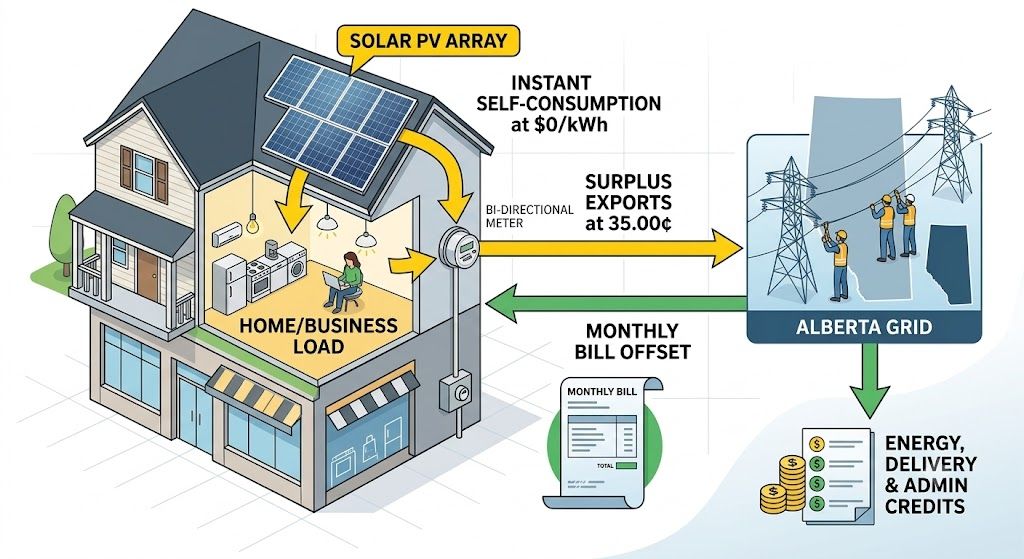
Rather than netting kilowatt-hours 1-to-1 over an entire year, your bi-directional meter continuously tracks every kilowatt-hour imported from or exported to the grid. At the end of each monthly billing cycle, your retailer multiplies your exported energy by your active Solar Club rate.
The resulting monetary credit is applied directly against your statement balance, offsetting energy charges, variable transmission and distribution fees, and fixed monthly administration charges. If your summer Alberta solar net-billing credits exceed your total bill, the remaining cash balance rolls forward to cover future winter heating costs or is paid out annually.
Residential and Commercial Rebates in Alberta
While residential solar owners maximize returns by pairing the Alberta Solar Club rate-switching mechanism with municipal financing, commercial operations are not eligible for the Solar Club program. Commercial adopters instead optimize their ROI by combining structural tax incentives, accelerated depreciation, and commercial energy financing:
| Incentive / Financing Tool | Eligibility & Scope | Financial Impact |
|---|---|---|
| Clean Energy Improvement Program (CEIP) | Property owners in participating municipalities (Calgary, Edmonton, Canmore, St. Albert, Leduc, etc.) via the official CEIP Alberta Portal | Low-interest financing repaid conveniently through regular municipal property tax bills. |
| Federal Clean Technology ITC | Corporations, commercial businesses, and agricultural operations. | A 30% refundable investment tax credit on total capital hardware and installation costs. |
| Accelerated Capital Cost Allowance (CCA) | Commercial businesses under Class 43.1 / 43.2 tax rules | First-year depreciation write-off for qualifying solar PV and battery storage assets. |
| Municipal Cash Grants | Select local municipalities (e.g., Town of Banff) | Prescriptive cash-back rebates per watt of installed capacity up to municipal caps. |
Future-Proof Your Energy Portfolio
By leveraging Alberta's deregulated energy market and joining the Alberta Solar Club, your roof transforms from a passive operational overhead into an active revenue source. Stacking 35.00¢/kWh export rates with municipal CEIP property-tax financing delivers immediate bill relief and long-term energy independence.
Ready to optimize your solar generation? Contact our localized engineering team today to verify your grid hosting capacity, calculate your projected Alberta Solar Club 2026 rates return, and lock in your rate-switching plan.
[Request Your Free Alberta Solar & Solar Club Assessment Now]
People Also Ask
1. Can any solar owner in Alberta join the Alberta Solar Club?
Most grid-connected solar owners with a total capacity under 150 kW and a bi-directional cumulative meter can join, provided they select a participating UTILITYnet energy retailer. System owners located in the City of Medicine Hat or certain Rural Electrification Associations (REAs) may be subject to local utility rules.
2. What happens if I forget to switch from the HI rate back to the LO rate in winter?
If you remain on the 35.00¢/kWh HI rate during winter when your property imports more power than it exports, you will be billed 35.00¢/kWh for all imported grid power. Activating automated Alberta micro-generation rate switching via RateSwitch™ eliminates this risk by toggling your rate automatically.
3. Does membership require a long-term contract or exit penalty?
No. Participating retailers operate without long-term lock-ins or early termination penalties. Members can switch between HI and LO rates within the club or change energy providers with standard notice (typically 10 days).
4. How do net-billing credits offset distribution and transmission charges?
Monetary credits earned from exporting power at the 35.00¢/kWh rate accumulate on your overall account balance. This dollar credit offsets your baseline energy consumption, variable delivery fees (distribution and transmission), and fixed monthly administrative charges.
5. Is the CEIP financing program stackable with Solar Club rates?
Yes. The CEIP Alberta solar rebate financing structure operates independently on your municipal property tax bill. You can finance up to 100% of your solar installation via CEIP while simultaneously earning 35.00¢/kWh export credits on your utility bill through the Solar Club.